

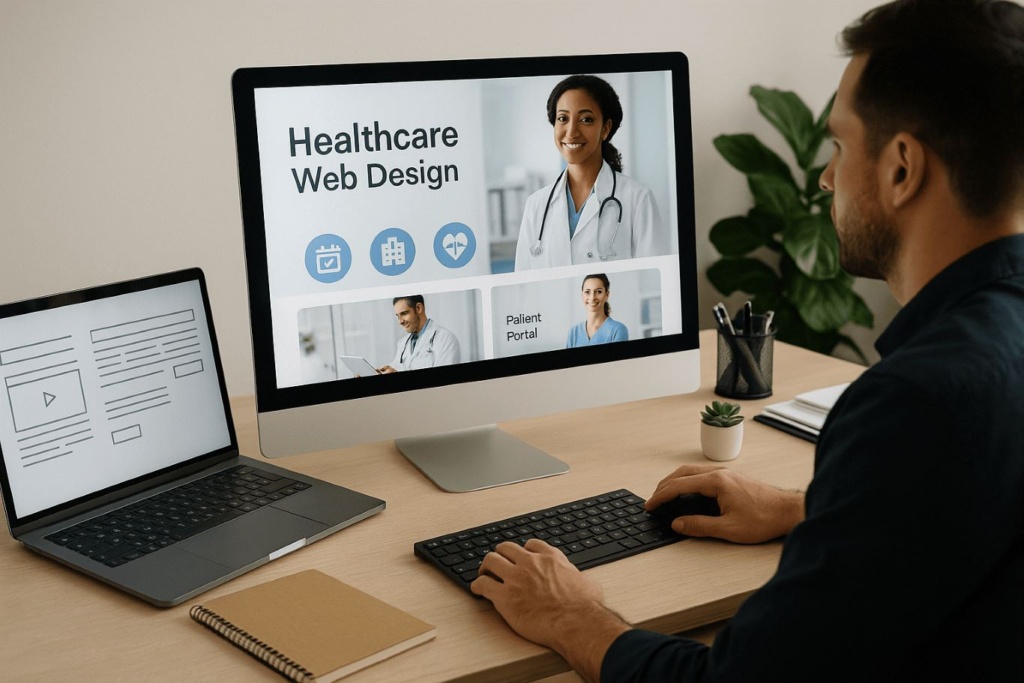
Top Web Design Trends of 2025 is a comprehensive guide that explains all about web design for healthcare.
Welcome to our complete guide for healthcare web design. Whether you are in the Web Design Industry, or just starting to get comfortable, this guide is about how-to apply Web design for healthcare in terms of material to help you understand what it is and why website design for healthcare matters and how it can be put to practical use.
Healthcare web design is a process that is intended for the creation of websites or the betterment of existing ones for healthcare purposes. Such services cover hospitals, clinics, varied public centers, providers of telemedicine, and various health-tech startups. Designing a website requires combining functionality, user experience, and a touchpoint each of aesthetic value while it adheres to standards like HIPAA and regulations governing accessibility of websites in order to streamline smooth and secure movement in-between patient and physician.
A modern web design isn't just a luxury but is indispensable in today's internet-friendly world for providing digital platforms and patient expectations. Until August 2025, more than 85% of patients have started to research doctors online before seeing them. This means that your website is the initial impression, and a poor design may worsen the chances of getting patients.
Better web design in the healthcare industry may even introduce the following services:
- Small fragments have been introduced in order to provide listeners with clear, understandable and quick access to certain kinds of information, including contact details, online appointment schedules, and insurance particulars.
- It will be implemented in an in-built fashion for mobile phones because the resources for many people are accessed through their smartphones.
- In addition to following strict principles regarding patient data, the system also includes the data rights and encryption compliances in terms of the healthcare sector in the United States.
- This is a complete portal, and from a patient service and support perspective, there is also the provision of online prescription management, and there will also be a live chat where you can quickly triage a patient.
- White, sterile, and yet friendly UI/UX design elements that alleviate patient anxiety and create trust reset the counters.
Why website design for healthcare Matters for Web Design Trends
Due to its ever-evolving nature, the World Wide Web sets the pace, causing healthcare websites to really be on the frontline if they are to stay relevant. Patients expect that by 2025, healthcare providers' websites will not only be easily accessed, but are likely to be more user-friendly in comparison to similar digital experiences already available in other sectors, like online banking or retail stores. It is vital that the industry quickly adopt new trends in website design.
Indeed, the real-time manifestation of telehealth solutions with AI-powered symptom checkers must encapsulate strong UI/UX. So, while it's believable to escape “useable” for healthcare website design alone, it must speak something dynamic, genius, and emotionally supportive.
An account of how some modern web design trends emerging in 2025 change the way healthcare websites are designed:
1. Personalized User Experiences Powered by AI
The addition of AI in healthcare websites allows the sites to offer personalized content by designing a patient's digital journey while browsing through medical information. So returning patients could see reminders to follow up, health alerts tailored to a specific location, or suggestions from a wellness blog that are completely catered to them because the contents are based on previous internet history or on the basis of their medical records.
Each feature that is integrated into the generation of customized content by AI can make the latest healthcare-related web technologies to seem more user-oriented, as it goes on to add to the user's experience in reinforcing higher levels of engagement-a scenario where the performance measures are worthy of entertainment demands.
2. Voice User Interfaces (VUIs)
Due to the collected emergence of smart speakers and mobile voice assistants, VUIs have started gaining popularity across industries. To become an accessible and hands-free way for all users especially for older or disabled populations, health websites are now meticulously incorporating voice search and voice-controlled navigation.
Expect voice design to be a default mode and not a fancy, in 2025, when the healthcare industry will see the next generation of all-inclusive healthcare web design.
3. Microinteractions for Patient Comfort
A number one great matter for patient experiences online is micro-interactions. Micro-interactions are minute design elements or animated effects that react to the behavior of the user. A simple hover animation, button click feedback, or on-screen success animation upon form submission can help the user feel more confident in using digital healthcare.
More so, every latest web design trend by 2025 in health care tightens up user experience in an emotionally intelligent and more intuitive way due to the demographic tendency of patients to approach healthcare services emotionally stressed or anxious.
4. Emotionally Intelligent Color Schemes and Typography
Web design for healthcare beyond 2025 moves away from sharp whites to calm and credible visual tones. Soft blues, greens, and natural palettes are being mostly used in the design instead of harsh whites to give a more inviting visual appearance. The typography has hardly become more human across its wondrous round fonts and clear readability in a bid to accommodate all age brackets and visual abilities.
This is in line with the holistic shift to a psychologically-sensitive UI design, which sets a mood of calm and comfort the moment users log in.
5. Ultra-Fast Loading Speeds and Minimalist Design
From all else, modern web design is ensured to feature performance beyond design. After all, in healthcare, time is money. This is crucial for access to critical health information since people in need may be discouraged from visiting a page that loads slowly. Site speed and minimal design will therefore be the main issues for the leading healthcare websites in 2025.
By disregarding visually offensive details, speed will still get better. Likewise, without too many clicks, the health care provider and mobile design characteristics engaged the client where simplicity lies: the navigation. This is how improving user satisfaction and engagement rates can be done: through maintenance.
6. ADA-Compliant and Accessible Web Experiences
Accessibility prevents you from breaching the law, and that should be looked at as a reality. Healthcare websites must properly comply with the WCAG 2.2 regulations and this would mean that it should cater to all the elements in the web just as a person with disability has access to navigating around the website and interacting with it. Among many features included in several web pages: keyboard navigation, compatibility with screen readers, alt tags for graphics, and very distinguishable color contrast for users with vision problems.
Experienced professionals will appreciate the broadened coverage of new healthcare issues and understanding of the concept of inclusion and empathy as key values in the universe of healthcare.
Understanding how the website designs for healthcare influence your comparison of paid advertising could spell the success or demise of you as an improvement. Next, we'll see some real-life results.
Benefits of website design for healthcare
- Web design for healthcare increases trust and accessibility to a patient: An effectively designed website sells credibility, making it easier for patients to navigate, find a provider, and establish appointments. Features like ADA-compliance elements, mobile responsiveness, intuitive user flows, enable every demographic in the easiest use, resulting in increased patient satisfaction and loyalty.
- Consistent growth in web design trends for supporting innovation. Innovatively channeling AI-powered chatbots, secure patient portals, and personalized health content gears the healthcare website industry toward boosting digital transformation. Such efforts constitute the current best practices in web designing while they grow toward future trends.
- Moving forward with meticulous planning, this will be a sturdy establishment upon which the transformation can happen. By using responsive frameworks such as Bootstrap or Tailwind CSS along with optimized CMS platforms like WordPress and Drupal, ensure ongoing operations.
website design for healthcare vs. Alternatives
| Criteria | website design for healthcare | Alternative |
| Effectiveness | High | Moderate |
| Ease of Use | Simple | More Complex |
| SEO Impact | Strong | Varies |
Implementing website design for healthcare in Real Scenarios
When delving into website design for healthcare, the first step would be identifying the gaps as far as the modern website design strategy of the present is concerned. This would essentially mean using tools such as content and keyword audits to identify gaps in enhancements. Better it to match the demands of the users and their search behavior.
Such as redesigning site navigation and simplifying call-to-action buttons led 40% percent more appointment requests over a short three-month period for, instance, one community clinic. Modular design for collapsible panes made the site friendlier to use for older visitors—a critical healthcare demographic. With processes of this collective part, a seemingly small investment into design programs may ultimately result in quantifiable improvements in both usability tests and actual appointments being held.
There is a possibility that private practices and hospitals could accrue benefits by incorporating Electronic Health Records (EHRs) directly on their websites. It allows the use of user-owned health metrics while keeping patients still under compliance with the Health Insurance Portability and Accountability Act (HIPAA). Latest web design methodologies provide plugins and safe APIs enabling a higher level of accessibility for such functionality.
Another effective method is using structured data, particularly schema markup. Schemas specific to the health sector, which includes types such as , , and , become the best way to make the information that you provide more visible in local searches and mobile voice search. When done properly, technical search engine optimization would provide health-related questions asked by patients directly with your services and also enhance your ranking in search engines.
What can actually help clinicians respond faster to patients is real-time tools. For example, having live chat portal cut off consultation hours won't be as useful when the symptoms are an emergency medical condition--instead of checking to see if there's a nurse they can talk to in the middle of the night, it shifts from helping to hagwashi symptoms to cancer. Conversely, it might be more beneficial during consultation hours--on the verge of booking a day appointment that is still unknown.
Healthcare websites have brand identity as well as design features. The best part is that the website maps have that edge with a design that is new and modern. On the other hand, mood emerges by using white spaces, an appropriate choice of font for readability, soft colors that make the portal transparent. When patients enter your site, they must have the feeling of peacefulness, and, most of all, being informed about what medical help you are offering to them-not that they should be overwhelmed with too many items through cluttered or altered visuals.
Additionally, it needs to be considered that the web design should also be designed for the devices. Presently, more than 65% of all future health care consumer experiences take place on their mobile phones. Hence, the primary concerns should be to build an effective responsive design and to increase the speed of the mobile page. Optimizing images, compressing codes, and enabling lazy load will enhance the delivery speed for all devices.
In the end, traditional UX testing must be combined with feedback loops. The heat maps, user surveys, and A/B monitoring are effective in improving customer experience. Health care needs change, and so must your digital presence. Continuous iteration based on the behavior of real users ensures that the site will not only be useable but will also grow to be a significant part of patient care and marketing strategy.
Frequently Asked Questions
What is website design for healthcare in simple terms?
Website design for healthcare is about purposefulness or strategic adoption to picture the novel strategies required in the area of modern web design while maintaining a structured expectation in the field to continue executing design.
How does website design for healthcare help?
It is advantageous in terms of getting similarity between the content-based features and method of search behavior according to industrial norms and best practices.
Can I apply website design for healthcare myself?
Yes, a simple way to apply any guideline from the beginning, and even beginners can start working with these principles effectively.
What tools should I use?
You could opt, for example, for Google Search Console, SEMrush, or keyword research tools. They allow you to get an understanding of how website design for healthcare (and the plan) and all related terms alter the business.
Best Practices for Modern Healthcare Website Design
Building a healthcare website isn't just one about giving it a professional look— it should be very communicative, and would need to be compliant, load quickly, and accessible to all types of users. So, to keep your healthcare website engaging and functioning quite effectively, follow these best practices:
- Responsive Mobile: Increasingly, mobile-empowered healthcare consumers are likely to access information, which means that websites need to adjust automatically to clean layout and clickable features on mobile devices.
- Compliance with HIPAA: All online forms, messaging systems, and every other aspect of data collection need to meet the demands for compliance and safeguard the protection of patient data in the framework of HIPAA.
- Optimization for Quick Loading: Compress the images, make caching a must-have, and make use of a good CDN to ensure that the site loads very fast, the importance of which is user retention and search engine visibility.
- Clear Navigation: So, the patients can easily get through with all their goods and have contact with all health services, get an appointment made, and view Intra-provider Bios within a few clicks.
- Website Design Guided by SEO Best Practices: Take a more modern approach to website design according to SEO best practices, such as schema for medical contents, alt text, keyword strategies and a quick, crawlable architecture.
Why Modern Web Design is Crucial for Healthcare
Modern web design is now not just for the sake of being trendy but rather a must, especially in today's tough interactive world. Healthcare really needs to have itself represented digitally and made credible, as well. This is to forge a bond with end target or potential consumers by displaying websites that would in turn convert gains to visitors and also enhance literacy about health. In dynamic content, appointment booking and symptom checkers, and chatbot technology made possible through AI-the ever-evolving digital landscapes-that most of the healthcare websites are standing to reap benefits from the online sphere in the provision of services.
The importance of a well-crafted website can never be underestimated as patients check websites first before hospital visits for their routine or specific inquiries. A worthy healthcare website in modern times should display to the local and national netizens when they are looking for online medical information. This is done by adding the latest tools and technologies to create that 'wow' looking site, guiding them comfortably around, with dynamic content, enlightening them with health facts, and engaging with patients through chatbots.
Next Steps
Your health website should represent your unique brand, instill trust, and enable appointments to be made absolutely at all points of time. Our specialists in the digital field are ready to help make significant changes or small improvements. Get your digital presence upgraded today.
Request Your Free Digital Marketing Consultation Today!
Take Action Now
The first move toward online empowerment is finding the right partnership to work with. At Link2City, that means specializing in healthcare website design that's supplemented with cutting-edge modern web design and proven marketing techniques. We focus on clinics that look at healthcare, dental practice, urgent care centers, and wellness brands to boost visibility and their performance.
Want to learn more? Check out our in-depth guides:
- The Complete Guide to Healthcare Marketing
- Top Healthcare Web Design Trends in 2024
Explore authoritative industry knowledge: