
However, you will find in Paying Social Ads vs. Google Ads: Which One is Better? all the information you will need concerning PPC management for the small business. It will feature tips, examples, and strategies to get better results.
Hello, thank you for joining us as we delve into more detailed information on PPC management for the small business. One can be in the Paid Advertising Strategy business or just started, and this article unveils what it is like in PPC management for small businesses and why it is crucial and how to apply it effectively.
What is PPC management for small businesses?
Small businesses typically have limited resources and cannot afford hefty campaign expenditures. So, PPC management should be tweaked according to very tight budgets, which will still turn out competitive results. The crux of productive PPC management is association of wise mechanisms during every stage-from demographic targeting and keyword selection to ad creatives with an A/B testing.
PPC Management for smaller companies should require sensible planning and execution in terms of management such that the paid advertising on various platforms, such as Google Ads or social media networks like Facebook, Instagram, LinkedIn, or TikTok, may become optimized. The objective is to generate targeted traffic, increase conversions, and maximize ad spend returns (ROAS) even with very small budgets.
Typically, smaller firms would lack the actual resources to be used in campaigns on a grand scale. So today the management of PPC should be tailored to the requirements of the tighter financial boundaries but, meanwhile, must ensure bright results. Through demographic targeting and keywords, up to ad creatives and A/B testing, effective PPC management will be maximized at each stop.
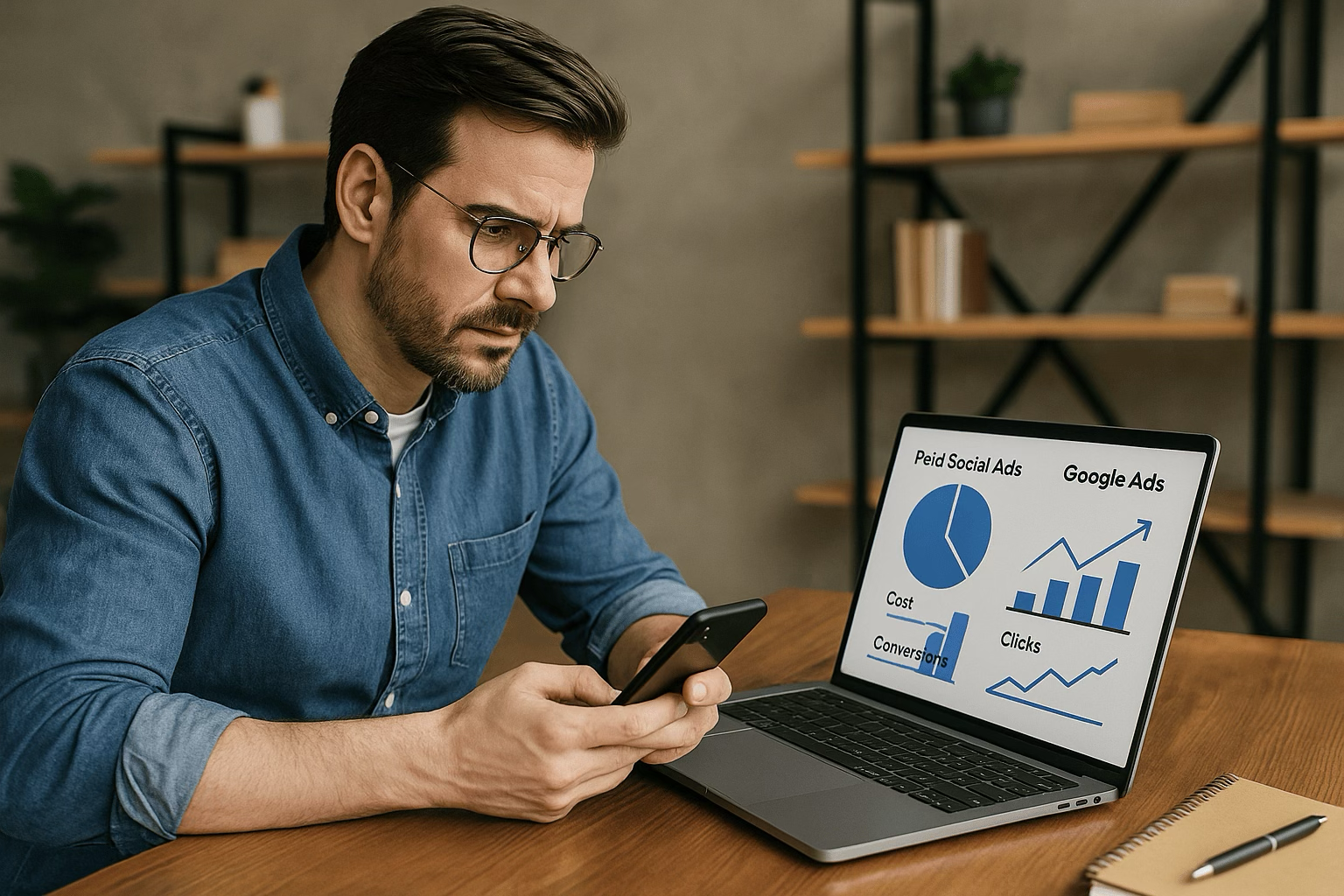
There are two major categories when talking about PPC advertising: search engine advertising with the search engine giant itself and social media advertising that is typically referred to as paid social ads. Both of them offer their unique strengths and setups in processes, which necessitate having at least one of them included in a digital marketing strategy.
Google Ads usually feature in search engine results pages (SERPs) when potential clients actively look for your offers. This is different from paid social ads, which are shown in people feeds when they engage with their community, interests, or content—having highly advanced audience targeting while being more intrusive in its engagement and less serendipitous in user search intent.
Why PPC Management for Small Businesses Matters for Paid Advertising Strategy
In reality, PPC's tracks steer away from being a mere perquisite and be very much a must-have for smaller businesses looking to play ball with giants. Through PPC, brands discover and manage their audiences very fast and cost-effectively. It gets trackable metrics, real-time concepts, and flexibility for scaling based on performances.
Organic reach on platforms like Facebook and Instagram are dwindling, and SEO through Google is getting fortifying. It has changed the facet of paid advertising from luxury to a necessity. The situation is simple, small budgeting. A successful selection of platforms, the most optimization inputs will be added and have sustained success.
Google Ads is going to witness most-intent-generated traffic when it comes to online paid advertising initiatives. If people are searching for "emergency plumber near me"-you better bet that they are very much on the buying side. Google PPC management is closely following the keyword bidding portion which aims to convert a high-valued click via user intent.
Social ads are even more engaging and better for brand awareness. Using one of those two platforms, Instagram or Facebook, businesses put forward their products or services with some amazing visuals and videos. This caters to those audiences that are not in a shopping mode yet because they can be nurtured into leads by remarketing through ads.
The most effective management of PPC is adapting to the unique features of each platform. The points of differences, against what we had earlier, indicate:
- Google Ads: It motivates more to users' actions, which is why there are ads as long as users are dreaming of finding a solution. Great for direct response situations, like lead capture and e-commerce sales.
- Paid Social Ads is the best tool to get started in platforms such as Mindshare, which are the most ideal for brand awareness, storytelling, and reaching out to impressions in the top part of the funnel. By means of very sophisticated/advanced, demographic, specific targeting, such as interests, behaviors, job titles, and more, social media marketing makes things easier even for the small business owner.
The Cost Factor
Usually, Cost Per Click (CPC) varies significantly between platforms. For example, Google Ads is competitive in terms of CPCs within niches, but becomes expensive in times of high competition for keywords within segments like real estate, insurance, law, among others. On the other hand, CPCs for paid social campaigns are generally low, especially when it comes to brand-building efforts; thus, these lead building funnels could be long before leads convert.
That is why it is crucial for small businesses to have experienced PPC management: expenditure on the right places is assured, while tracking is in place to also measure meaningful results such as ROAS (return on ad spend), CPA (cost per acquisition), and CTR (click-through rate).
Platform Evolution As of August 2025
It was August, 2025, when both Google Ads and paid social platforms have actually evolved a lot. Campaigns creation and optimization methodologies changed totally with the adoption of improved AI-driven features. Now Google Ads features are any too high a performance, so performance max campaigns have been introduced by Google wherein now advertisers can have a single campaign structure power by AI and access all Google networks (YouTube, Display, Search, Shopping, Gmail).
Paid social platforms like Meta (Facebook & Instagram), LinkedIn, and even TikTok have put forward advanced automation tool with real-time audience insights. Creative optimization tools using AI create the ad visuals and messages so that small businesses can have an edge without employing a full time designer or an analyst.
Both positive and negative, PPC management for small businesses has tremendous impact on the pay-per-click comparison performance. For better understanding of your own potential success, we’ll move to some real-world examples.
Benefits of PPC management for small businesses
- Small business pay-per-click marketing can boost search engine company visibility by placing them right alongside bigger opponents in any given budget suze. Unlike organic SEO which can take at least several months to achieve visibility, even if nothing impactful arises, PPC provides immediate visibility both time and audience-wise.
- Consistent enhancement with Paid Media Strategy, since users can observe the ROI by each single ad real-time. Small businesses can track which ads convert, what keywords are active, and how much each click/those clicks cost. It will allow you to take quick decisions at different points in your budget adjustments.
- Easy application through a good structure, namely Google Ads and MSN AdCenter come with very good solutions of providing some automated recommendations like keyword proposals and other inbuilt analytics and statistics. Contrary to that opinion that an enterprise should have a great marketing team to head into it, providing structured campaigns, such as ads in organized clusters and catchy ad content can lead to some remarkable gains even for newbies in the paid ad game.
PPC management for small businesses vs. Alternatives
|
Criteria |
PPC management for small businesses |
Alternative
|
|
Effectiveness |
High |
Moderate |
|
Ease of Use |
Simple |
More Complex |
|
SEO Impact |
Strong |
Varies |
In comparing the various paid advertising strategies and platforms, small business owners face a challenge in choosing the most effective contribution with their ROI. A comparison of paid advertising shows that in contrast, Google Ads can be set up very quickly for data-driven conversions, while social media could require more nuanced content creation and acceleration of all the organic resources.
Google Ads and Bing Ads are likely to be the superior players in PPC management for small business owners since these two tools allow greater accuracy in geo-targeting, keyword optimization, dayparting (choosing the time of day for ads to be displayed), compared to display advertising or influencer partnerships-apart from the fact that not all metrics are immediately convertible-especially when budget-conscious entrepreneurs want to know what works when working on a tight budget.
It usually takes several months for SEO implementation to be really effective but weeds due to the fact that changes in algorithms can significantly undo all improvement or SEO efforts. In the meantime, PPC management remains a more effective means because it can be consistently maintained. Real-time optimization is possible, and the A/B testing ability allows ongoing improvements, without the need for permanent changes on your website.
Implementing PPC management for small businesses in Real Scenarios
To be followed with small business PPC management, identifying gaps in the comparison strategies applied to the existing advertising online is the way to start. Keyword tools and content audit would be inevitable for spotting opportunities for improvement. Customize the content by understanding user intent and search behavior.
Let's imagine you are a local bakery, and you would like to invite people into your shop. In such a situation of targeting foot traffic, PPC can build a local ad that targets people in a five-mile radius. With high-volume keywords such as "fresh donuts near me" or "artisan bread in [city]", your ad is right on target with the needs of the search user, leading to much more click-throughs.
For service-based small businesses, such as plumbing or accounting services providers within a certain locality, PPC allows you to bid on keywords that relate to immediate needs or services provided at certain parts of the year, like "24-hour plumber" or even tax season services. By adding in extensions to the main ads, which could be as simple as a phone call-away facility or feedback on the customer site, you may increase further conversion chances without requiring the user to delve too much into your website.
Another beautiful picture would be a practical instance of an e-commerce store offering a range of products that are eco-friendly. Shopping ads are added in maximum quality images, prices of products, and limited period offers. When working in combination, all such visuals and on-the-dot laser precision targeting that analyze search behavior, and lure buying intent will enable site visitors to establish a quicker decision on buying.
These PPC campaigns provide complete control over the budget. Retailers can determine the limit for the day, raise and lower the bids on keywords, switch off low-traffic ads, and reallocate the funds to another higher-functioning track. This is how small businesses can ensure their spending is always yielding measurable outcomes.
Advanced analytics solutions such as these integrate platforms into Google Analytics and Google Ads that allow for tracking metrics such as conversions, bounce rates, and customer journey paths: this data is critical to refine in-flight strategies and overall understanding of user behavior.
Further, a method that is highly effective in lowering the per-customer advertising costs are the remarketing lists for search ads (RLSA). In a very small amount of time, companies will have an opportunity to re-capture people that have been to their site but, for one reason or another, were not converted initially, resulting in a rather low initial cost of capturing a customer since returning visitors are cheaper.
All the more true in contexts where fast changes attack a number of sectors and health products, seasonal retail, and even technology. What happens is that you can determine results more quickly, and use that learning to pivot much faster, invest more boldly in what drives revenue.
Frequently Asked Questions
What is PPC management for small businesses in simple terms?
This refers to the organization and ideas on how a business improves comparison against paid advertising by setting solid, conscious methods.
How does PPC management for small businesses help?
It helps in ensuring better performance at the time of aligning your content search behavior with industry best practices.
Can I apply PPC management for small businesses myself?
Absolutely. One can even start to apply the principles, and even complete beginners can do so if they have the right tools and organization.
What tools should I use?
Initiate yourself with Google Webmaster Tools, SEMrush, and keyword search tools. This will ensure the PPC management for small business has an impact on the performance.
Next Steps
The great thing about PPC management of small businesses is that the process is a full-time occupation after you run an ad. It isn't just about launching ads—it's about optimization, analysis, and continuous improvement. By monitoring the PPC on your behalf translating cost-per-click (CPC) dynamics and eradicating wasteful spending, particularly, leveraging geography to target ads, and performing an A/B test regularly, businesses can perform better in their paid advertising.
Among its most significant benefits is that you can actually measure it. Keep in mind that using pay per click (PPC) is a very direct form of advertising against traditional advertisements. This stuff is about real-time monitoring, which would bring huge benefits to small businesses. The data-driven approach saves both time and money, enabling quick shifts of tactics whenever necessary and utilizing successful campaigns.
Additionally, this would allow small businesses to interact with customers at all times of their journey, thanks to using retargeting strategies and funnel-based advertising. Whether it is for a retargeting of an existing visitor on a website, abandoners of shopping carts, or new customers scrolling through the social media links, PPC allows for customization of messages to any of your segments segmented.
Proper paid advertising comparison relative to every other strategy, say SEO, email marketing, organic social media, has demonstrated that PPC will provide faster results. It becomes absolutely a great part of advertising, especially at the times known for large sales, launch, or time-bound promotions. Businesses can alter the ad creative on a real-time basis while evaluating performance and scaling budgets in a manner that static marketing cannot.
But partnering with professionals who're good at it, like small business agencies, which specialize heavily on PPC management makes a difference if there is access to the full potential of PPC. It's not only the existing campaigns that they go one step further, but they stay attuned to emerging trends and bidding algorithms, changes to keyword research, and major platform alterations—like updates on Google Ads or Meta advertising policies.
Be it a penny-pinching situation or having even a little plethora of moolah to set aside for marketing, PPC stands as one among a very few channels that will keep on generating returns on investment. If the digital strategy comparison is still in its inception, an exhaustive comparative analysis of paid advertising could best tell where PPC falls in the wider objectives-and how it can be an alternative to long-term efforts such as content marketing and SEO.
Request Your Free Digital Marketing Consultation Today!
Ready to take the next step? Let us help you create a customized PPC strategy tailored specifically for your small business needs.
- Talk to a PPC Specialist at Link2City
- Explore Our PPC Management Services
- What is Pay-Per-Click? (Investopedia)
- Latest PPC Tips (Search Engine Journal)
Don't wait to let your competitors take the lead—maximize your visibility and ROI starting today.