
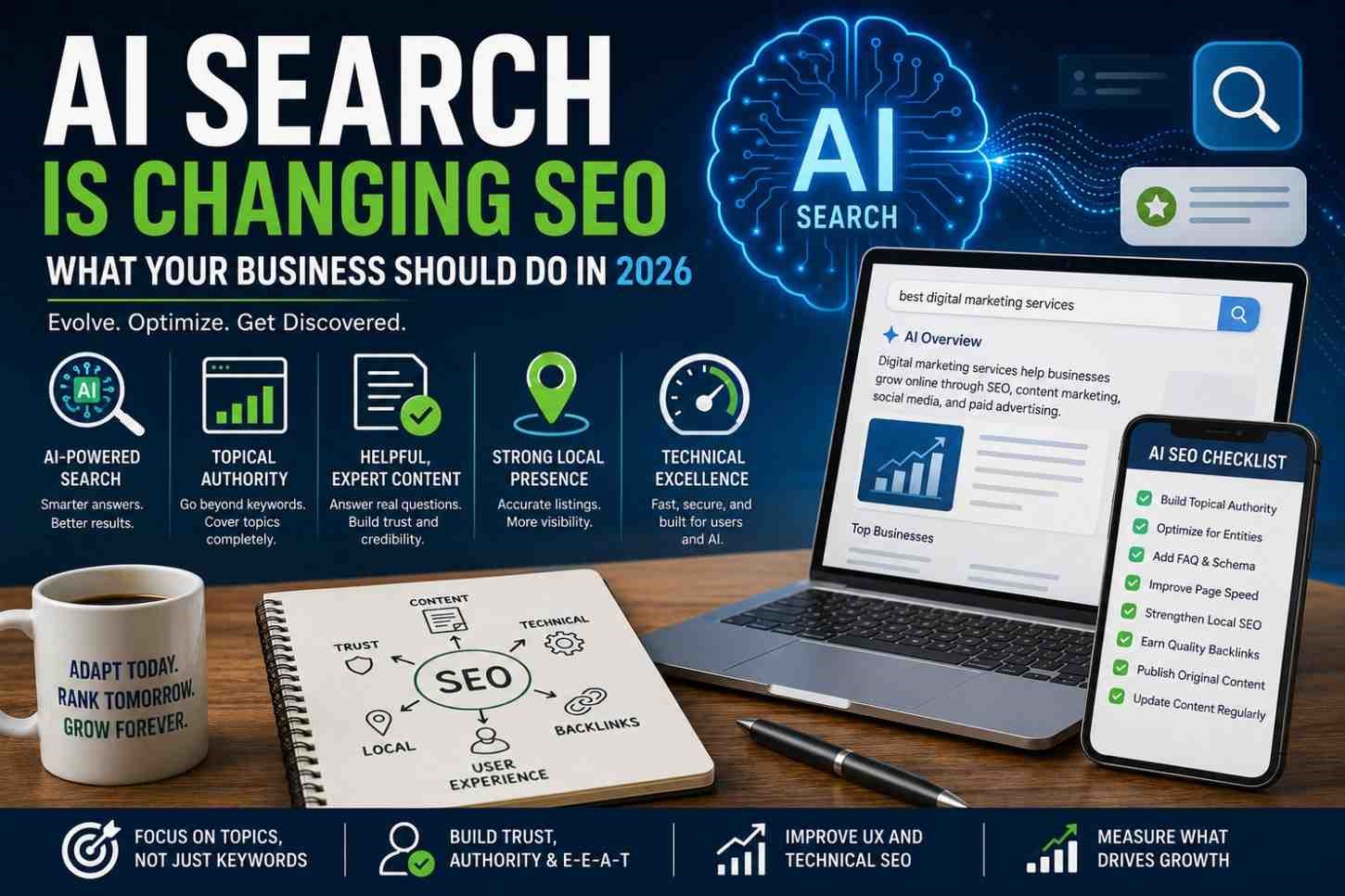
Local search is no longer just a list of blue links followed by a map pack. AI-powered search experiences are changing how people ask questions, compare businesses, evaluate services, and decide who to contact. Instead of typing a short phrase such as “roof repair Miami,” a customer can ask a much more detailed question: “Which roofing companies near me handle flat-roof leaks, have strong reviews, and offer emergency service?”
That shift matters because AI search systems are designed to synthesize information from multiple sources and present a useful answer. A business may still need strong traditional rankings, but it also needs to be easy for search engines and AI systems to understand, verify, and confidently recommend.
For local businesses, this creates a broader optimization challenge. Local SEO still matters. Google still says local results are primarily influenced by relevance, distance, and prominence. But businesses now also need content that answers specific questions, consistent business information across the web, clear service and location signals, strong reviews, and enough authority to be cited or referenced in AI-generated results.
This guide explains how AI search is changing local SEO, what remains important, and how businesses can adapt their websites and local presence for traditional search, AI Overviews, conversational search, answer engines, and generative discovery.
What Is AI Search?
AI search uses generative artificial intelligence to interpret a question, gather or reason across information, and produce a synthesized response. Instead of requiring users to open several search results and assemble an answer themselves, the search experience can summarize options, explain differences, and support follow-up questions.
Google has expanded AI Overviews and AI Mode as major parts of Search. In June 2026, Google reported that AI Overviews had more than 2.5 billion monthly active users and AI Mode had surpassed one billion monthly users. Google has also said people are asking new kinds of longer and more complex questions through these experiences.
This does not mean websites are disappearing. AI search responses still surface links and source material. But the path from query to website visit is changing. Businesses must compete not only for a ranking position, but also for inclusion in the information an AI system considers useful enough to cite, summarize, or recommend.
Traditional Local SEO vs. AI-Driven Local Search
|
Area |
Traditional Local SEO |
AI-Driven Local Search |
|
Query style |
Short keywords and location modifiers |
Conversational, detailed, multi-part questions |
|
Primary goal |
Rank in organic results and local pack |
Be understood, trusted, cited, and recommended |
|
Content focus |
Keywords, service pages, location pages |
Direct answers, entities, expertise, comparisons, context |
|
Business data |
Google Business Profile and citations |
Consistent entity information across multiple trusted sources |
|
Reviews |
Ranking and conversion signal |
Reputation evidence and descriptive context |
|
Website structure |
Crawlability and on-page SEO |
Crawlability plus clear machine-readable relationships and answers |
|
Measurement |
Rankings, traffic, calls, leads |
Rankings plus citations, AI visibility, branded demand, conversions |
Local SEO Is Not Dead
AI search changes the interface, not the need for strong local signals. Google's current Business Profile guidance continues to identify relevance, distance, and prominence as the main factors behind local results.
Relevance measures how closely a business matches the search. Distance considers how far the business is from the searcher or location specified. Prominence reflects how well known the business is, including information Google finds across the web, links, articles, directories, reviews, and traditional organic visibility.
That foundation is important because AI search still needs reliable underlying information. A poorly optimized business with inconsistent hours, vague services, weak reviews, thin website content, and conflicting directory listings gives search systems less confidence about what the business actually does.
1. Search Queries Are Becoming Longer and More Conversational
Traditional keyword research often focused on short phrases such as “personal injury lawyer Miami,” “plumber near me,” or “best dentist Orlando.” Those queries still matter, but AI search encourages people to ask complete questions.
Examples include:
- Who is a good family dentist near Coral Gables that accepts new patients and offers Saturday appointments?
- What should I look for when choosing a collision repair shop in Miami?
- Which local HVAC company handles commercial rooftop units and emergency repairs?
- Is SEO or Google Ads better for a small business trying to generate leads in South Florida?
These queries contain multiple layers of intent. A business must communicate not only its primary service and location, but also specialties, differentiators, customer concerns, availability, process, expertise, and proof.
What This Means for Content Strategy
Build content around real customer questions instead of creating pages solely around exact-match keywords. Service pages should answer the questions a prospect would ask before contacting the business.
A useful page can explain who the service is for, what problems it solves, how the process works, what factors affect cost or timing, common mistakes, local considerations, and what makes the provider qualified.
2. Being Understandable Is Becoming as Important as Ranking
An AI system must understand the business before it can confidently reference it. That means your digital presence should clearly establish the core entity: business name, category, services, service areas, address or service-area status, phone number, website, leadership, credentials, and reputation.
Ambiguous websites create problems. If the homepage uses clever branding language but never clearly explains what the company does or where it operates, both customers and machines have to work harder.
Strong local SEO in the AI era favors clarity.
3. Google Business Profile Remains a Core Local Asset
For businesses that qualify for a Google Business Profile, the profile remains one of the strongest sources of structured local information.
Google recommends keeping business information complete and accurate, verifying the business, maintaining accurate hours, managing reviews, and adding relevant photos or other available profile information.
For AI-driven discovery, a complete profile can also reinforce the relationship between the business, its services, its physical or service area, its reputation, and its website.
Businesses should review:
- Primary and secondary categories
- Business name and contact information
- Hours and holiday hours
- Service areas
- Services and descriptions
- Website and appointment links where applicable
- Photos and videos
- Reviews and owner responses
- Attributes available for the business category
4. Reviews Are Becoming Richer Local Search Data
Reviews have always mattered for trust and local visibility. Google explicitly notes that review count and review score can influence local ranking.
In an AI-driven search environment, reviews can also provide contextual information about the customer experience. A detailed review may mention the exact service performed, neighborhood, staff member, speed, communication, or outcome.
For example, “Great company” provides limited context. A legitimate customer review explaining that a contractor repaired a leaking flat roof in Miami Beach and communicated throughout the insurance process contains far more descriptive information.
Businesses should never manufacture reviews or dictate what customers must say. Instead, create a consistent process for asking real customers for honest feedback after successful service.
5. Local Content Must Answer Questions, Not Just Target Keywords
Pages written only to repeat a city and service keyword are increasingly weak. Useful local content should satisfy the underlying question.
For a local law firm, that could mean explaining what to do after a Florida accident, how comparative negligence works, or what evidence can strengthen an injury claim. For a home service company, it could mean explaining repair timelines, maintenance decisions, costs, warning signs, and local climate considerations.
This is where traditional SEO overlaps with Answer Engine Optimization, or AEO. AEO structures information so a search engine or AI system can quickly identify a direct, useful answer.
6. AEO Is Becoming Part of Local SEO
Answer Engine Optimization focuses on making content easy to retrieve and use when someone asks a question.
Useful AEO practices include:
- Clear question-based headings
- Direct answers near the beginning of relevant sections
- Logical H1, H2, and H3 hierarchy
- Concise definitions
- Step-by-step processes
- Comparison tables
- FAQs that answer genuine customer questions
- Specific examples
- Supporting evidence and authoritative sources
The goal is not to write robotic content for machines. It is to make high-quality human content easier to interpret.
7. GEO Expands the Optimization Target
Generative Engine Optimization, or GEO, focuses on improving a brand's ability to be discovered, understood, and potentially referenced by generative AI systems.
For a local business, GEO overlaps heavily with good SEO, reputation management, digital PR, entity consistency, and useful content.
A practical local GEO strategy asks:
- Can an AI system clearly identify what this business does?
- Can it verify where the business operates?
- Are important claims supported?
- Does the business have authoritative mentions outside its own website?
- Does the website provide original, useful information?
- Are reviews and citations consistent with the brand's claims?
- Is the content specific enough to answer detailed customer questions?
8. Entity Consistency Matters More Across the Web
Local businesses often think of citations only as directory listings. In AI search, the larger issue is entity consistency.
Search systems can encounter a business through its website, Google Business Profile, social profiles, industry directories, local chambers, news articles, review platforms, professional associations, and other sources.
When those sources agree on the business name, location, services, phone number, website, and expertise, the entity is easier to understand. When they conflict, confidence can fall.
Audit major business listings and correct outdated names, phone numbers, addresses, categories, URLs, and descriptions.
9. Location Pages Need More Than a City Name
A weak location page changes only the city name while repeating the same generic copy. That creates little value for users.
A strong location page should contain genuinely local information when relevant:
- Services available in that market
- Neighborhoods or service areas
- Local office details
- Directions or parking information for physical locations
- Local regulations or conditions affecting the service
- Case studies or projects from the area when appropriate
- Customer testimonials from that market when authentic
- Local FAQs
- Clear contact and conversion options
The objective is to demonstrate real relevance to the location, not simply insert geographic keywords.
10. Original Experience Can Differentiate Local Businesses
AI can generate generic explanations quickly. That makes original experience more valuable.
Local businesses can publish information competitors cannot easily copy:
- Before-and-after project examples
- Local case studies
- Original photographs
- Common problems observed by technicians or professionals
- Internal data and trends
- Expert commentary
- Local pricing factors without making unsupported guarantees
- Customer questions collected by sales or support teams
This type of content strengthens credibility because it demonstrates actual operating experience rather than repeating generic information found across the web.
11. Structured Data Helps Clarify Meaning
Schema markup and other structured data can help search engines understand information about an organization, local business, service, article, breadcrumb structure, and other page elements when the markup accurately reflects visible content.
Structured data is not a shortcut to rankings or AI citations. It should support a clear website rather than compensate for weak content.
Use valid, relevant markup and keep it consistent with what users can see on the page.
12. Authority Still Matters
Google's description of prominence includes links, articles, directories, reviews, and web search position. That means traditional authority-building remains relevant.
For local businesses, authority can come from:
- Local news coverage
- Industry associations
- Professional directories
- Community organizations
- Supplier or partner websites
- Local sponsorships with legitimate web mentions
- Expert contributions
- High-quality editorial links
Avoid buying low-quality links or mass-producing artificial citations. The objective is to build real prominence and verifiable relationships.
13. Brand Search Demand May Become More Important
As AI answers more informational questions directly, businesses should pay closer attention to whether customers recognize and search for the brand itself.
A strong brand can generate branded searches, direct visits, repeat customers, referrals, reviews, and mentions. Those signals also strengthen the broader prominence of the business online.
SEO should therefore work with brand marketing, public relations, social media, reputation management, email, and paid media rather than operate as an isolated channel.
14. Conversion Optimization Matters When Clicks Are Harder to Win
If AI search answers more questions before a user visits a website, every qualified click becomes more valuable.
Local landing pages should make the next action obvious:
- Call
- Request a quote
- Schedule a consultation
- Book an appointment
- Get directions
- Submit a short lead form
Remove unnecessary friction. Use clear calls to action, fast mobile performance, visible trust signals, simple forms, and service-specific landing pages.
15. Local SEO Measurement Needs to Evolve
Rank tracking remains useful, but it no longer tells the whole story. AI-generated results can vary by query wording, location, personalization, and follow-up context.
A modern local SEO dashboard should consider:
- Organic leads and calls
- Google Business Profile interactions
- Local pack visibility
- Organic landing-page traffic
- Branded search growth
- Conversions by service and location
- Review growth and sentiment
- Referral traffic from relevant sources
- AI or generative search referral traffic when identifiable
- Visibility for question-based and long-tail queries
Google has also introduced new Search Console tools and insights intended to help website owners navigate AI in Search, making measurement an area businesses should continue to watch.
What AI Search Means for the Local Customer Journey
The customer journey can now compress several traditional research steps into one conversation.
|
Customer Stage |
Traditional Behavior |
AI Search Behavior |
|
Discovery |
Search a broad service keyword |
Ask for recommended local options matching several criteria |
|
Research |
Open multiple websites |
Ask AI to explain services and differences |
|
Comparison |
Compare tabs and reviews manually |
Ask for a side-by-side comparison |
|
Validation |
Check reviews and credentials |
Ask follow-up questions about reputation or qualifications |
|
Action |
Return to preferred website |
Click, call, navigate, or continue researching |
How Local Businesses Should Adapt: A 12-Step Plan
- Audit your Google Business Profile for completeness and accuracy.
- Make your core services and locations obvious on the website.
- Create dedicated pages for important services instead of forcing everything onto one page.
- Improve location pages with real local information.
- Build content around customer questions and decision points.
- Add concise answers, FAQs, comparisons, and process explanations.
- Strengthen internal linking between service, location, blog, and contact pages.
- Audit business information across important directories and profiles.
- Create a consistent process for earning legitimate customer reviews.
- Publish original experience, examples, case studies, and expert insights.
- Build local and industry authority through legitimate mentions and links.
- Measure leads and conversions, not rankings alone.
A Practical Content Model for AI Local SEO
A local business does not need hundreds of shallow pages. It needs a connected content system that answers the questions customers ask throughout the buying journey.
A strong structure can include:
- Homepage: clear entity, services, market, trust, and primary conversion path
- Service pages: detailed explanations of each important service
- Location pages: genuine local relevance for priority markets
- Industry or audience pages: specialized solutions where useful
- Blog/resource content: questions, comparisons, guides, problems, and trends
- Case studies: evidence of real work and outcomes
- FAQ content: concise answers to recurring questions
- About/team pages: expertise, credentials, and brand legitimacy
Internal links should connect these assets so users and search engines can understand the relationships among topics.
Example: A Local HVAC Company Before and After AI Optimization
Imagine an HVAC company whose website says only that it provides “quality heating and cooling services.” Its Google Business Profile is incomplete, service pages are thin, and reviews are rarely requested.
A stronger AI-ready local presence would clearly document residential and commercial services, emergency availability, service areas, equipment expertise, financing information where applicable, common repair problems, maintenance guidance, customer reviews, technician qualifications, and local project examples.
The company could then publish content answering questions such as how to tell whether an AC needs repair or replacement, why systems struggle during extreme local heat, what affects replacement cost, and how often commercial rooftop units should be serviced.
The result is a much richer entity. Search engines have more evidence about what the company does, where it operates, and why it may be relevant to a detailed customer question.
What Businesses Should Not Do
Do Not Mass-Produce Thin AI Content
Publishing hundreds of lightly edited pages does not create authority. Content should serve a real user purpose and add useful information.
Do Not Create Fake Locations
Do not invent offices or addresses to manipulate local visibility. Keep location information accurate and consistent.
Do Not Stuff Keywords Into Every Paragraph
Natural language and topical completeness are more useful than forced repetition. Use target phrases where they improve clarity.
Do Not Treat Schema as a Ranking Trick
Structured data should accurately represent visible information. It is a communication layer, not a substitute for authority or content quality.
Do Not Ignore Traditional SEO
Technical SEO, internal linking, crawlability, page speed, mobile usability, backlinks, and strong on-page optimization remain important foundations.
Do Not Optimize Only for AI Citations
The business objective is leads, customers, and revenue. AI visibility is useful only when it supports those outcomes.
SEO, AEO, and GEO Should Work Together
|
Discipline |
Primary Focus |
Local Example |
Business Outcome |
|
SEO |
Search visibility and rankings |
Optimize a Miami web design service page |
Qualified organic traffic |
|
Local SEO |
Geographic relevance and local prominence |
Optimize Business Profile and local pages |
Calls, directions, local leads |
|
AEO |
Direct answers to questions |
Answer “How much does local SEO cost?” clearly |
Answer visibility and trust |
|
GEO |
Generative discovery and citation potential |
Build clear, authoritative brand and topic signals |
Visibility in AI-assisted research |
Frequently Asked Questions
Is AI search replacing local SEO?
No. Local SEO remains essential because AI systems still need reliable information about businesses, services, locations, reputation, and authority. The optimization target is expanding rather than disappearing.
Does Google Business Profile still matter with AI search?
Yes. Google Business Profile remains a core source of local business information, and Google continues to identify relevance, distance, and prominence as the main factors behind local results.
What is AEO for local businesses?
Answer Engine Optimization structures useful content so search and AI systems can quickly identify clear answers to customer questions. It commonly uses question-based headings, direct answers, FAQs, comparisons, and well-organized content.
What is GEO in local SEO?
Generative Engine Optimization focuses on making a business easy for generative AI systems to understand, verify, and potentially reference. It overlaps with SEO, content quality, entity consistency, authority, and reputation.
Do reviews help with AI local search?
Reviews support reputation and local prominence. Detailed legitimate reviews can also provide contextual information about services and customer experiences. Businesses should ask real customers for honest feedback without manipulating the content.
Should local businesses create more blog content because of AI?
Only when the content answers real customer questions or supports the buying journey. Quality, specificity, and original experience matter more than publishing large volumes of generic articles.
Are keywords still important?
Yes, but keyword optimization should reflect natural language and search intent. Businesses should also cover related questions, entities, services, locations, and decision factors.
Can schema markup make my business appear in AI answers?
There is no guaranteed markup that forces inclusion in an AI answer. Accurate structured data can help search engines understand page information, but it should support strong content and a trustworthy web presence.
How should I measure AI search performance?
Track leads, calls, conversions, local visibility, branded search, organic traffic, Business Profile interactions, question-based visibility, and identifiable AI referral traffic. Avoid relying on one ranking metric.
What is the first step for a local business adapting to AI search?
Start with the fundamentals: accurate business information, a complete Google Business Profile, clear service and location pages, strong reviews, useful customer-focused content, and consistent information across trusted sources.
The Bottom Line: Local SEO Is Becoming a Trust and Understanding Game
AI search is changing how customers discover local businesses, but it is not eliminating the fundamentals of local visibility. Relevance, distance, prominence, strong websites, accurate business information, reviews, authority, and useful content still matter.
What is changing is the level of understanding search systems can attempt to build. A business now needs to be clear enough for machines to interpret, credible enough to trust, useful enough to cite, and persuasive enough to convert the customer once attention is earned.
The businesses that adapt will not treat SEO, AEO, GEO, content, reputation, and conversion optimization as separate projects. They will build one connected digital presence that clearly answers three questions: Who are you? Why should a customer trust you? And are you the right solution for this specific need?
Build an AI-Ready Local SEO Strategy With Link2City
Local search is moving quickly, and businesses that rely only on yesterday's SEO tactics risk losing visibility as customer behavior changes.
Link2City helps businesses build integrated search strategies across technical SEO, Local SEO, Google Business Profile optimization, content, AEO, GEO, reputation, and conversion-focused web experiences.
If you want to understand how your business currently appears across traditional search and AI-driven discovery, contact Link2City for a strategic review and a practical plan to improve local visibility, authority, and lead generation.
Recommended Internal Links
- Link2City homepage - Insert the verified live Link2City URL before publishing.
- Search Engine Optimization (SEO) service page - Insert the verified live Link2City URL before publishing.
- Local SEO / Google Business Profile service page - Insert the verified live Link2City URL before publishing.
- Web Design & Development service page - Insert the verified live Link2City URL before publishing.
- Online Reputation Management service page - Insert the verified live Link2City URL before publishing.
- Why Every Local Business Needs Answer Engine Optimization (AEO) blog - Insert the verified live Link2City URL before publishing.
- What Is GEO and How Can Businesses Optimize for Generative Search? blog - Insert the verified live Link2City URL before publishing.
- Contact page - Insert the verified live Link2City URL before publishing.
Authority Sources
- Google Business Profile Help - Tips to improve your local ranking on Google
- Google Search - New opportunities, control and insights for website owners (June 2026)
- Google Search - A new era for AI Search (May 2026)
- Google Search - How AI Mode and AI Overviews help users explore the web (May 2026)
- Microsoft Bing Search Blog - Introducing Bing generative search