
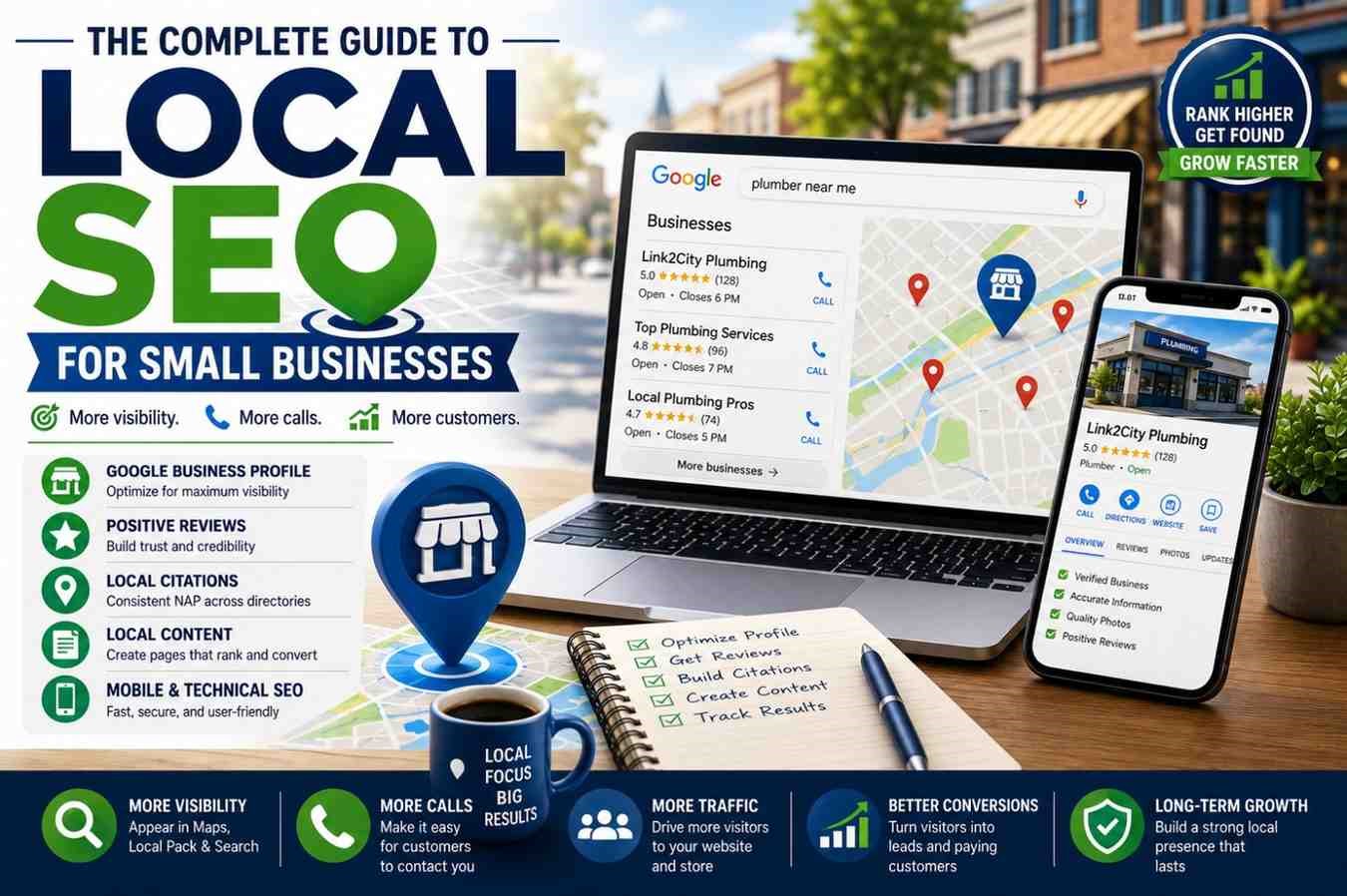
Local SEO determines whether a business is visible when nearby customers search for products, services, professionals, or places. For many companies, that visibility can directly influence calls, website visits, direction requests, appointments, and revenue.
But local rankings are not controlled by one tactic. Google says local results are primarily based on relevance, distance, and prominence. Those three concepts are supported by many practical signals, including Google Business Profile information, reviews, website content, links, articles, directories, and overall organic search visibility.
The challenge is separating confirmed guidance from SEO myths. No legitimate agency can guarantee a top-three Maps position, and there is no single setting that makes a business rank everywhere.
This guide explains the local SEO ranking factors businesses should focus on in 2026, how each factor affects visibility, and what companies can realistically do to improve their local search presence.
How Google Local Search Works
When someone searches for a local business, Google attempts to identify the options most useful for that search.
The exact results can vary depending on:
- What the user searches
- Where the user is located
- The location included in the query
- The relevance of nearby businesses
- The prominence of those businesses
- Available business information
This is why two people can search the same phrase from different neighborhoods and see different local results.
The Three Core Local Ranking Factors
Google publicly identifies relevance, distance, and prominence as the main factors used to determine local results.
|
Factor |
Meaning |
Can You Influence It? |
Primary Focus |
|
Relevance |
How well the business matches the search |
Yes, substantially |
Categories, services, content, complete information |
|
Distance |
How far the business is from the searcher or specified location |
Limited |
Accurate real-world location and service area |
|
Prominence |
How well known and authoritative the business appears |
Yes |
Reviews, links, articles, directories, organic visibility |
1. Relevance: How Closely Does the Business Match the Search?
Relevance is Google's assessment of how well a Business Profile matches what the customer is looking for.
A complete profile gives Google more information about the business and can improve its ability to match the profile to relevant searches.
Businesses can strengthen relevance by clearly defining:
- Primary business category
- Additional relevant categories
- Services
- Products where applicable
- Business description
- Website content
- Location and service area
- Hours
The objective is accuracy, not keyword stuffing.
2. Distance: Where Is the Business Relative to the Searcher?
Distance measures how far a potential search result is from the location used in the search.
If the user does not specify a location, Google can estimate distance based on what it knows about the searcher's location.
This is one of the least controllable ranking factors. A business cannot legitimately optimize its way out of physical geography.
Creating fake offices, virtual locations, or misleading addresses to appear closer to searchers can violate Google Business Profile policies and create suspension risk.
3. Prominence: How Well Known Is the Business?
Prominence reflects how well known a business is in the real world and online.
Google says it considers information from across the web, including links, articles, and directories. Google also states that review count and review score can influence local ranking, and that a business's position in web results is a factor.
Prominence is where Local SEO connects with broader SEO, reputation management, digital PR, citations, and brand building.
4. Google Business Profile Completeness
Google recommends entering complete and accurate business information because businesses with complete information are more likely to appear for relevant local searches.
Important profile fields include:
- Business name
- Address or service area
- Phone number
- Website
- Business category
- Hours
- Services
- Attributes
- Photos
Incomplete information can weaken both visibility and conversion.
5. Primary Business Category
The primary category is one of the strongest relevance choices available inside Google Business Profile.
Google recommends selecting the category that best represents the business's core activity and using the most specific option available.
Do not choose a category merely because it has high search volume. The category should accurately describe the real business.
6. Additional Categories
Additional categories can help describe substantial secondary aspects of the business.
Google recommends using as few categories as necessary to describe the overall core business.
Adding unrelated categories does not create legitimate relevance. Review category options periodically because Google can add, remove, or rename them.
7. Accurate Business Name
Google requires the Business Profile name to reflect the business's real-world name as used consistently on signage, branding, website, and business materials.
Adding extra city names, services, or keywords solely to manipulate rankings can violate policy.
A compliant profile protects the long-term stability of the listing. Short-term ranking tactics are not worth creating suspension risk.
8. Address and Service-Area Accuracy
Google Business Profile should represent a real, eligible business location or service-area operation.
Businesses that serve customers at a storefront should use their real customer-facing address. Service-area businesses that travel to customers and do not receive customers at the address should configure the profile accordingly.
Virtual offices and remote mailboxes are generally not eligible business locations. Coworking locations must meet Google's specific requirements.
9. Review Quantity
Google explicitly states that more reviews can help local ranking.
Review volume also influences customers. A business with a steady history of legitimate feedback can appear more established than a competitor with very little social proof.
Build a repeatable process for asking real customers for honest reviews after successful interactions.
10. Review Rating and Quality
Google says positive ratings can help local ranking. But the business value of reviews extends beyond the algorithm.
Customers read reviews to evaluate:
- Service quality
- Responsiveness
- Professionalism
- Communication
- Timeliness
- Problem resolution
- Consistency
Do not buy reviews or create fake feedback. Review manipulation can create platform, legal, and reputation risk.
11. Review Responses
Google recommends responding to reviews. Responses show customers that the business values feedback.
A response does not need to be long. It should be professional, specific where appropriate, and respectful.
For negative reviews, avoid arguing publicly or revealing private customer information. Move detailed resolution offline when possible.
12. Website Organic Rankings
Local SEO and traditional organic SEO are connected. Google explicitly says a business's position in web results is a local ranking factor.
That means the website should not be treated as secondary to the Business Profile.
A strong local website needs:
- Technical SEO
- Useful service pages
- Location relevance
- Internal linking
- Quality content
- Mobile usability
- Strong page experience
- Authority and backlinks
A competitive organic presence can strengthen the broader prominence of the business.
13. Local Service Pages
Each major service should have enough useful information for a customer and search engine to understand what the business offers.
A strong service page can explain:
- What the service includes
- Who needs it
- Common problems
- The process
- Timing
- Pricing factors
- Service area
- FAQs
- Why the business is qualified
- How to contact the company
Avoid combining every service into a few vague paragraphs on the homepage.
14. Location Pages
Businesses serving multiple meaningful markets may benefit from useful location pages.
But a location page should contain more than a city name inserted into generic text.
Useful local information can include:
- Services offered in that area
- Neighborhoods served
- Local office details
- Local project examples
- Customer testimonials from that market
- Local regulations or conditions
- Directions and parking for physical offices
- Local FAQs
Do not create fake offices or misleading location pages.
15. On-Page SEO Signals
Traditional on-page optimization helps search engines understand the topic and geographic relevance of a page.
Important elements include:
- Clear title tag
- Relevant H1
- Logical H2 and H3 structure
- Natural service and location language
- Useful body content
- Internal links
- Descriptive image alt text
- Accurate contact information
Keyword repetition should never make the content unnatural.
16. Backlinks
Links from other websites remain part of the broader authority ecosystem. Google specifically identifies links as one source of prominence information for local results.
Useful local and industry link opportunities can come from:
- Local news
- Professional associations
- Chambers of commerce
- Community organizations
- Suppliers and partners
- Industry publications
- Legitimate sponsorships
- Expert contributions
Quality and relevance matter more than buying large quantities of low-value links.
17. Citations and Directory Consistency
Google says prominence can be informed by directories and other information across the web.
For Local SEO, the practical priority is accurate business entity information.
Audit important directories for:
- Business name
- Address
- Phone
- Website
- Categories
- Hours
Do not spend resources chasing every obscure directory. Prioritize major, relevant, trustworthy sources.
18. Brand Mentions and Local Authority
A business can become more prominent through real-world and online recognition.
Local press coverage, community involvement, expert commentary, partnerships, awards, industry participation, and strong customer reputation can strengthen brand authority.
The best Local SEO often looks like good business marketing because prominence cannot be manufactured entirely inside a Google profile.
19. Photos and Visual Content
Google recommends adding photos and videos to Business Profiles. Visual content can improve how customers evaluate a company and understand its products, location, team, or work.
Useful images include:
- Exterior signage
- Interior
- Team
- Products
- Completed projects
- Equipment
- Before-and-after examples where appropriate
Use real, current, high-quality images whenever possible.
20. Business Hours and Availability
Accurate hours improve customer experience and profile completeness.
Use special hours for holidays or temporary changes where applicable. Incorrect hours can create negative customer experiences and lost opportunities.
For businesses where availability is a major differentiator, clearly communicate legitimate operating hours and emergency service information without making misleading claims.
21. Mobile Website Experience
Local searches frequently lead to mobile website visits. A customer may want to call, get directions, book, or request a quote immediately.
The website should:
- Load quickly
- Use readable text
- Have responsive navigation
- Make phone numbers easy to use
- Keep forms simple
- Avoid disruptive overlays
- Keep important CTAs visible
Mobile usability supports both SEO and conversion.
22. Website Speed and Core Web Vitals
Core Web Vitals are part of Google's broader page experience systems. Good performance does not guarantee high rankings, but a slow and unstable site can create a poor user experience.
Focus on Largest Contentful Paint, Interaction to Next Paint, and Cumulative Layout Shift, along with overall mobile usability and server performance.
23. Internal Linking
Internal links help search engines and users understand the relationships among services, locations, educational content, and conversion pages.
A useful local structure might connect:
- Homepage to core service pages
- Service pages to relevant locations
- Location pages to services
- Blogs to service pages
- Related articles to each other
- All commercial paths to appropriate contact actions
Use descriptive anchor text rather than generic phrases.
24. Local Content and Topical Authority
Local businesses can strengthen relevance by answering questions customers ask before making a decision.
Examples include:
- Cost factors
- Timelines
- Comparisons
- Local laws or regulations
- Seasonal issues
- Common problems
- Maintenance guidance
- Insurance questions
- What to do after an event
Useful content supports SEO, AEO, and the customer's research journey.
25. Answer Engine Optimization
AI-assisted search encourages longer and more conversational questions. Answer Engine Optimization helps structure content so systems and users can identify direct answers.
Useful AEO techniques include:
- Question-based headings
- Concise direct answers
- FAQs
- Step-by-step explanations
- Comparison tables
- Clear definitions
- Original examples
AEO should extend strong SEO, not replace it.
26. Generative Engine Optimization and Entity Clarity
Generative Engine Optimization focuses on making a brand and its expertise easier for AI systems to understand and potentially reference.
For local businesses, that means maintaining consistent entity information, publishing credible content, earning legitimate mentions, building reviews, and clearly demonstrating service and geographic relevance.
Google's current guidance says established SEO best practices remain important for its generative AI search features.
27. Structured Data
Relevant structured data can help search engines understand organizations, local businesses, articles, breadcrumbs, and other supported content types.
Structured data is not a guaranteed ranking boost. It should accurately reflect visible page content and follow search engine guidelines.
Use it as a clarity tool, not a manipulation tactic.
28. Behavioral and Conversion Considerations
Businesses often confuse conversion signals with confirmed ranking factors. Not every useful marketing metric is a direct Google ranking signal.
Calls, form submissions, booking rates, and website engagement are still essential because the objective of Local SEO is business growth, not ranking screenshots.
Measure what happens after visibility is earned.
What Local SEO Factors Should You Prioritize?
|
Priority |
Factor |
Why It Matters |
Action |
|
High |
GBP accuracy and categories |
Directly supports relevance |
Complete and audit profile |
|
High |
Reviews |
Supports prominence and conversion |
Build legitimate review process |
|
High |
Website SEO |
Organic position supports local prominence |
Improve technical and on-page SEO |
|
High |
Service and location content |
Supports relevance and customer intent |
Build useful pages |
|
High |
Links and authority |
Supports prominence |
Earn legitimate mentions and links |
|
Medium |
Citation consistency |
Reinforces entity accuracy |
Correct major directories |
|
Medium |
Photos and profile maintenance |
Supports customer confidence |
Update regularly |
|
Medium |
AEO and AI-ready content |
Supports conversational discovery |
Answer customer questions |
|
Ongoing |
Performance measurement |
Connects SEO to revenue |
Track calls, leads, and conversions |
Local SEO Myths to Avoid
Myth 1: You Can Pay Google for Better Organic Maps Rankings
Google says there is no way to request or pay for a better local ranking.
Myth 2: Adding More Keywords to the Business Name Always Helps
The profile name must reflect the real-world business name. Keyword stuffing can violate guidelines.
Myth 3: A Virtual Office Lets You Rank in Another City
Virtual offices are generally not eligible. Misleading locations create suspension risk.
Myth 4: More Categories Are Always Better
Categories should accurately describe the core business. Google recommends using as few as necessary.
Myth 5: Google Business Profile Replaces the Website
Google explicitly connects web search position with local ranking. A strong website remains important.
Myth 6: Local SEO Is a One-Time Setup
Reviews, competitors, categories, website content, citations, search behavior, and platform features change. Local SEO requires ongoing management.
A 12-Step Local SEO Action Plan
- Claim, verify, and secure ownership of the Google Business Profile.
- Audit the business name, category, address, service area, phone, website, and hours.
- Choose the most accurate primary and additional categories.
- Complete services, attributes, photos, and relevant profile fields.
- Create a consistent process for earning legitimate reviews.
- Respond professionally to reviews.
- Build detailed pages for important services.
- Create useful location pages for real priority markets.
- Fix major citation inconsistencies.
- Earn legitimate local and industry links and mentions.
- Publish content around real customer questions.
- Track calls, forms, bookings, website conversions, and local visibility.
How to Measure Local SEO Performance
Rankings are useful, but they should not be the only KPI.
A stronger reporting framework includes:
- Qualified organic leads
- Calls
- Form submissions
- Bookings
- Direction requests
- Google Business Profile interactions
- Local pack visibility
- Organic landing-page traffic
- Branded search growth
- Review growth
- Conversion rate
- Revenue or qualified pipeline where trackable
Local rankings can vary by searcher location, so a single manual search is not an accurate performance report.
Frequently Asked Questions
What are the main local SEO ranking factors?
Google says local results are mainly based on relevance, distance, and prominence. Businesses can support these factors through accurate profile information, categories, reviews, website SEO, links, articles, directories, and useful local content.
What is the most important Google Maps ranking factor?
There is no single factor that controls rankings. Relevance, distance, and prominence work together, and results vary by query and searcher location.
Do Google reviews help local rankings?
Yes. Google states that more reviews and positive ratings can help local ranking. Reviews also strongly affect customer trust and conversion.
Do backlinks matter for Local SEO?
Yes. Google identifies links as one source used to determine prominence, and organic web position is also a local ranking factor.
Does the website affect Google Business Profile rankings?
Yes. Google states that a business's position in web results is a factor in local ranking. Strong website SEO supports the broader local strategy.
Can I rank in a city where I do not have an office?
A business may serve areas beyond its physical location, but distance remains a factor. Do not create fake or ineligible locations to manipulate rankings.
Does adding keywords to my Google Business Profile name help?
The business name should match real-world branding. Adding keywords solely for ranking purposes can violate Google's guidelines.
How long does Local SEO take?
There is no universal timeline. Results depend on competition, current visibility, website quality, reviews, authority, location, and the amount of work required.
Does AI search change Local SEO ranking factors?
AI search changes how users ask questions and discover businesses, but core local signals remain important. Strong SEO, entity clarity, useful content, reviews, and accurate business information support both traditional and AI-assisted discovery.
Can an SEO company guarantee top-three Maps rankings?
No legitimate provider can guarantee a specific organic local position because Google controls its ranking systems and results vary by relevance, distance, prominence, competition, and searcher location.
The Bottom Line: Local SEO Is Built on Relevance, Proximity, and Authority
Local SEO is not about finding one secret ranking factor. Google has consistently framed local results around relevance, distance, and prominence.
Businesses should focus on the factors they can legitimately influence: accurate Google Business Profile information, strong categories, reviews, website SEO, service and location content, authority, links, citations, page experience, and useful answers to customer questions.
Distance will always limit some searches. But businesses that build strong relevance and prominence can compete more effectively within the markets they realistically serve.
Improve Local Rankings With Link2City
A strong Local SEO strategy connects Google Business Profile optimization with website SEO, reputation management, content, citations, authority building, AEO, GEO, and conversion optimization.
Link2City helps businesses identify the gaps that are limiting local visibility and prioritize improvements based on search opportunity and business impact.
If your business is not generating enough visibility, calls, or leads from local search, contact Link2City for a Local SEO review and a practical strategy to improve your presence across Google Search, Maps, and AI-assisted discovery.
Recommended Internal Links
- Link2City homepage - Insert the verified live Link2City URL before publishing.
- SEO service page - Insert the verified live Link2City URL before publishing.
- Local SEO / Google Business Profile service page - Insert the verified live Link2City URL before publishing.
- Online Reputation Management service page - Insert the verified live Link2City URL before publishing.
- Google Business Profile Optimization Guide blog - Insert the verified live Link2City URL before publishing.
- Website Speed and SEO blog - Insert the verified live Link2City URL before publishing.
- How AI Search Is Changing Local SEO blog - Insert the verified live Link2City URL before publishing.
- Answer Engine Optimization for Local Businesses blog - Insert the verified live Link2City URL before publishing.
- Contact page - Insert the verified live Link2City URL before publishing.
Authority Sources
- Google Business Profile Help - Tips to improve your local ranking on Google
- Google Business Profile Help - Guidelines for representing your business on Google
- Google Search Central - SEO Starter Guide
- Google Search Central - Understanding page experience in Google Search results
- Google Search Central - Guidance for generative AI features in Google Search