

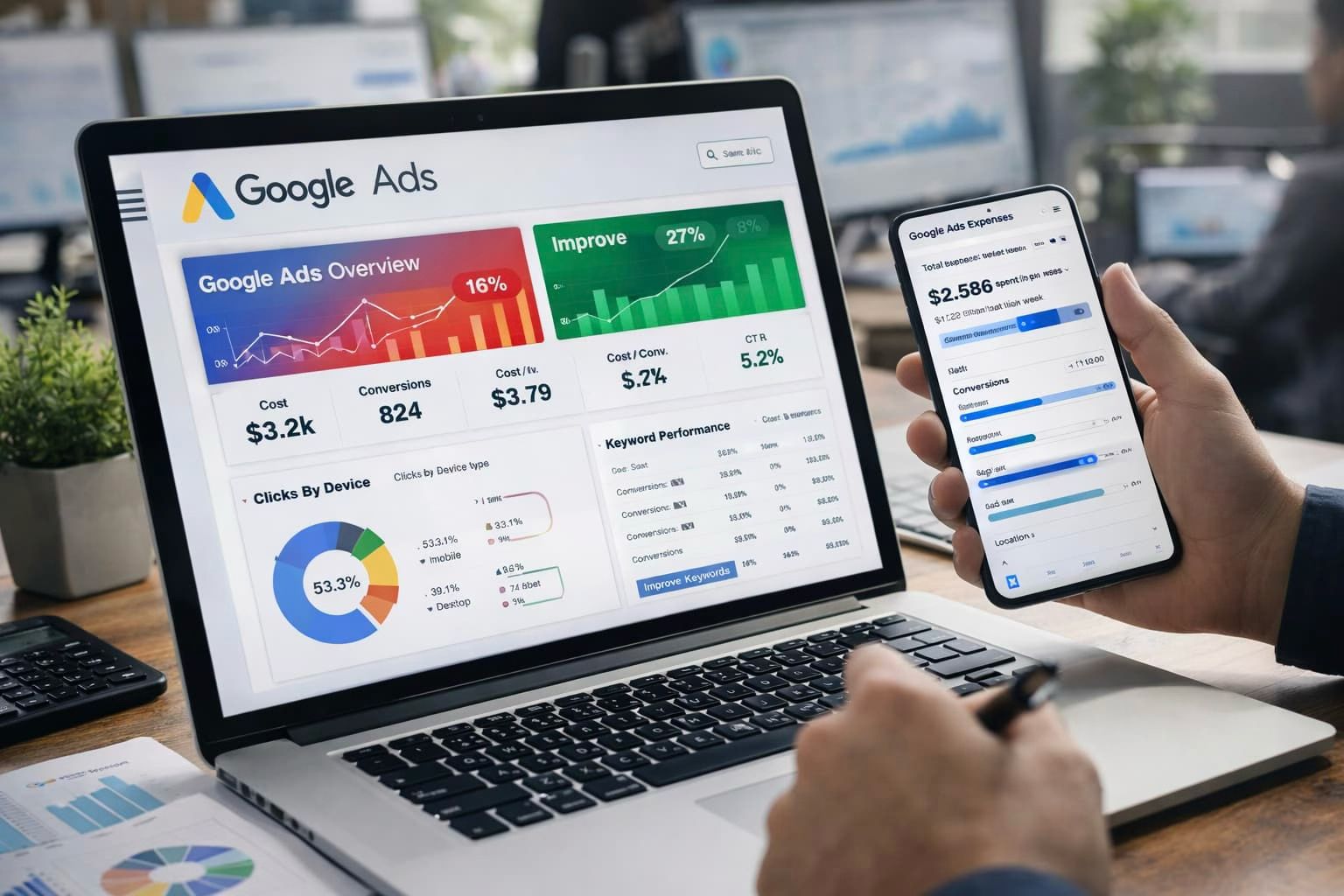
What is PPC management for small businesses?
PPC management for small businesses refers to the on-going planning, enterprising, and optimizing of pay-per-click advertising campaigns to make a small composition really work. As opposed to bigger firms which already have their pockets flowing with cash, smaller entities must adopt smarter strategies in implementing their ad budgets. To make PPC management work, right platforms need to be selected, goals need to be set, keywords need to be researched, ad copy written with urgencies and attributes, and continuously monitor and adjust the campaigns based on performance data.
Having insight and proper tools in use justify real money for even the smallest of startups in legitimately running paid advertising campaigns. Done through automation, with the power of AI, your business can easily harness sophisticated bidding strategies which ensures real-time analytics. This should help even very modest ad spenders to bring traffic and conversions to their sites pretty fast. While sweet as it sounds, spending money simply isn't in fashion. When you want to be more effective in using Google Ads, you must plan-it's about an ongoing process and it's about always refining your strategy. Finding and securing high conversion keywords on a shoestring budget today can work wonders for reducing CPC and maximizing return on your ad dollars.
Why PPC management for small businesses Matters for How-To Guides & SEO Tips
Competitive environments are commonly spotted in online fields of creativity, how-to guides, and SEO tips where small businesses may walk together for visibility in the market. While Organic SEO is indispensible, it takes some time and dedication for the results. For instant solution, there would be using the PPC tools, which can dish out everything for display customers' bids for the keyword on top of the search results immediately whereas it takes its time elevating organic search procedure. Those long into PPC management may have more chances of winning since the behavior of the customer is evolving. Campaign manager needs to work with Google for personalized search results now since search engines rate us ranked on the context of ads which would be the best tailored and contextually relevant ads given to the users. More along with it, systems such as account optimization cannot complete case ad optimization since sophisticated bidding strategies need to be employed for end-to-end management.
The management of pay-per-click advertising (PPC) prospects helps to enhance SEO strategies by SEO means. The result of campaigns, like the performance of keywords, rate of clicks, and user behavior, can help with creating an SEO strategy across the board. For example, when impressively performing keywords come out from a Google Ads campaign, such is a very good sign of reward on the keywords in organic content at the back.
Another area in Google's recent updates is quality and relevance. High scores although the Qualitiy Score metrics-CTR, ad relevance, landing page experience-tend to bring down the cost per click and enable better placements. It is much easier for small businesses doing everything well in PPC to capitalize on ROI and get a Bang for every buck thrown in.
Key Benefits of Effective PPC Management for Small Businesses
- Swift Campaign Performance: Vis-a-vis SEO, PPC ensures quick visibility and traffic, which is beneficial for promotions, openings, or timely information in August 2025.
- Precision in Targeting: Encroach on distinct audience sections based on location, device, browsing behavior, etc.
- Financial Control: Specify the daily or campaign budget; pay per click; fine-tune bids to suit the stripe your budget paints.
- Performance Monitoring: As experiments reveal, a keen eye is key: track your clicks, conversions or follow-on-dollar to know what's working and what's not.
- Scalable Performance: Your starting point might be modest; you can expand according to performance to apply less money on commercials, which, in turn, resonate better.
PPC, when properly guided, offers great mileage for tiny entities in the struggle against giants. The secret to this surely has to be accuracy; in place of every person, the little enterprise must aim to get to the right person at the right time and with the right message.
Understanding the Mindset: Small Budget, Big Strategy
Small businesses and small or mid-level enterprise incumbents also face an advertising realm that requires PPC management more than just massive spending. It consists of spending wisely. The scarce resources of a small business speak to the perfect, purpose-driven campaign reconciling with current business goals. Are you directing traffic to the newest blog post? Are you looking to generate inquiries through the landing page? Are you interested in promoting your seasonal products or services? All your accomplishments will define your campaign structure and set up your PPC budgets.
The cost of paid search does not matter in a way for small company owners, as they would prefer targeting broad match keywords that cost more and are faced by businesses having deep pockets. Thus, instead of focusing on high competition and broad match keywords, we will focus on long-tail search terms, a local target area approach, and value-driven offers. Analyzing your results will, ideally, allow you to cut off the campaigns that perform poorly while scaling up campaigns that perform well.
Smart PPC management in 2025 also means embracing automation software without total dependency on it. Google’s Smart Bidding strategies can benefit an advertiser in terms of cost-efficiency since it adjusts bids for each auction automatically. Nevertheless, manual intervention is indispensable. Regular perusal of performance data weekly guarantees your expenditures to be judicious and hence warrant timely changes. Understanding the implications of the small business PPC management on your paid ad budgeting is a good idea. Real examples will be dealt with next."
Benefits of PPC management for small businesses
- Managed PPC enhances visibility and ROI for small businesses: PPC gets your message straight into the hands of consumers searching for products or services. Accurate keyword targeting on platforms like Google Ads and Bing Ads thus helps small businesses reach the right audience instead of wasting resources on irrelevant users.
- Consistent growth owed to How-To Guides & SEO Tips: Matched with high-quality how-to hints and SEO tips, PPC campaigns serve as a push. While PPC pays guests for traffic instantly, SEO is a slow, long-term process that creates a lasting presence for the page. Specifically and in an all-around way, a clever use of PPC sees to it that even all-new content finds its way to the relevant segments quickly, ensuring increased feedback and much better engagement for the content.
- Simple implementation contends that one does not have to be technically literate to use PPC: one only needs a matchable structure as campaign architecture—as in developed ad groups, enticing copy, and mean landing experiences—and even the person still making it by for the first time will not fail at it. The ad platforms feature the capability to conduct guided setups as well as some form of managed automation as a matter of courtesy to a beginner in an enclosed system, thus attenuating the adverse learning curve.
PPC management for small businesses vs. Alternatives
|
Criteria |
PPC management for small businesses |
Alternative
|
|
Effectiveness |
High |
Moderate |
|
Ease of Use |
Simple |
More Complex |
|
SEO Impact |
Strong |
Varies |
Implementing PPC management for small businesses in Real Scenarios
If you are a small business, plan to create multiple services specific CPA campaigns. Would you be able to identify some keywords for the service campaign? A local bakery will want to split its campaigns between wedding cakes, pastries, and catering services. Each segment will contain keywords, ad copies, and landing pages in alignment with search intent for that segment. This way, when someone types up "custom wedding cakes near me," your ad is highly relevant and hence more likely to get converted. Consider setting up campaigns properly next. When you limit your ads to a service area when geotargeted, you prevent waste and give neighborhood businesses an advertising boost. Daily or monthly budgets give a more solid basis for expenditure control. If you don't wish to babysit the micromanagement of CPCs, CPAs, and placement bid adjustments, then use Target CPA or Maximize Conversions bidding.
The merging of PPC with existing content efforts is therefore advantageous. Identify high-performing how-to guides or blog posts where the visits are already focused and use PPC as a means of putting these pages before a wider audience. This will only work to boost the page's performance, which will increase backlinks and chisel out some level of authority over months that incidentally dovetail with SEO goals. Analyze your campaign/advertising on a regular basis so that you can comprehend what works the best and what needs to be abandoned. CTR (click-through rate), conversion rate, and Quality Score are quite some metrics that can help you read between the lines and know where you can make changes. For instance, an increase in quality score, in the long run, eventually increases your conversion rate, meaning you make good money.
A success story specific to the real world comes from small coaching businesses. When such businesses included PPC advertising in their public strategy, for a target-oriented group of people looking for online coaching programs on particular topics such as "long-distance running coach online" or "entrepreneur success mentor," it could result in the most rewarding advertising strategies to boost sales for the coaching services. Since these small businesses were already hardly picked up by the search engines for organic traffic on such long-tail keywords, PPC was the quick fix to be immediately visible to qualified leads- and the business now pools in tons of leads and revenue.
The combination of remarketing works best for one company. Indeed, it allows reintroducing, through ads, users who had previously visited a website but had not converted. Custom ads are used to guarantee more conversions of cold leads to hard-earned paying customers. This works without going for an extraordinary expense; remobilizing traffic without expensive expenditures on acquiring them. Clearly, financial considerations are vital depending on the outcome. With the advent of valuable paid ads budget tools, such as Google Performance Planner and third-party solutions like Optmyzr, one can set caps. Using these tools will help finesse campaign prediction based on different budget inputs and automatically propose some optimization suggestions.
The growth in capabilities like voice search targeting or detailed demographic targeting observed in PPC platforms forces small businesses to make a managerial choice on time, so they can chase after profit when their competitors are if not quite behind. The choice to use SEO or PPC is extremely difficult at the solve and may depend on whether one aims to have an agreeable compromise that will last in property or be utilized for making tech-assets.
Measuring Results and Scaling Strategically
While your PPC campaigns are off running, it is important that performance follow-ups are monitored. For small businesses, data-driven decision making is key for optimizing outcomes. With analytics platforms like Google Analytics and Google Ads detailed reports, one can track metrics like click-through rates, quality scores, conversion rates, and cost-per-click.
Gradual scaling of the PPC campaigns could be possible if executed systematically. Start by stepping up the campaign giving the highest return on ad spend (ROAS) before you reinvest money to a lot of same campaigns. Gradually expand keywords, stage through some newfound ad networks like Microsoft Ads, and get really easy with retargeting and video ads if the budget allows. You may run ad copy, landing pages, and bidding testings. Running these kinds of tests can help break additional areas of growth without trying to reinvent the wheel and detect recurrent successful patterns that can be used over and over again during the tweaking part of management in your little PPC world.
Optimizing Paid Ads Budgeting
A good PPC performance lies significantly in the clear budget-as-ads strategy. More often than not, small business owners overspend or under-allocate funds due to lack of a clear line of action. From the start, base your allocation on business goals. Are you focusing on customer acquisition, brand awareness, or lead generation?
Once the objective is clear, the strategy should define budgets based on campaign type and platform; for instance, allocate more funds to the campaigns that usually convert best and take advantage of ad scheduling to optimize spending during business peak hours.
In additional settings, be clear about daily or monthly spending limits to forestall any unforeseen hiccups. Regarding suggestion from Google-budiary recommendation and its budget planner tool, experiment with scenarios that include budget increases or decreases based on some of the greatest impact of model results so that you can gauge the impact and plan accordingly. Bear in mind, informed spending rubs along with the pre-conditions of making every dollar count where it is able to deliver desired results on its capper-voyage.
Integrating PPC with Other Digital Marketing Channels
PPC is largely a support to sales and digital marketing in an ecosystem. So, by harnessing PPC alongside others like SEO and social media campaigns and improving content marketing, they are sure to draw more conversions. In one case, you could run PPC to hope it promotes high performing blog content to solidify its search visibility organically, while capitalizing instant traffic.
Moving forward, data from paid search ads can be used by email marketing efforts, and could also be employed in social onboarding activities. A single messaging voice reinforcing the brand across all channels further enhances customer recall and trust.
Most importantly, using PPC data provides a clear picture of what should be focused on-whether keywords or anything else-in the organic SEO campaign. PPC data give you a host of clues into what should be adapted in terms of your whole digital campaign through what drives among whom.
Frequently Asked Questions
What is PPC management for small businesses in simple terms?
In this context, the PPC management requires deciding which keywords, ad copy, and landing pages must be developed.
How does PPC management for small businesses help?
When your material ultimately corresponds to the online manner by which Internet users and search engines relate, you would generally establish a positive image on the Web.
Can I apply PPC management for small businesses myself?
"Yes! These principles can be applied by even beginners once they know they have the right tools and method."
What tools should I use?
Begin with the Google Search Console and SEMrush, extending your SEM or using keyword research tools. All of them will help to show the effect of PPC management on small business performance.
Next Steps
Ready to grow your business with expert PPC strategies? Don’t leave your ad dollars to chance. Partner with a team of professionals who understand the intricacies of PPC management for small businesses and can help you get measurable results.
Request Your Free Digital Marketing Consultation Today!
Explore More & Stay Informed
Enhance your digital marketing knowledge by exploring:
- SEO Strategies for Small Businesses
- Social Media Marketing Guide
- Latest Google Ads Optimization Tips (via WordStream)
- PPC Data Analysis Best Practices (via HubSpot)