

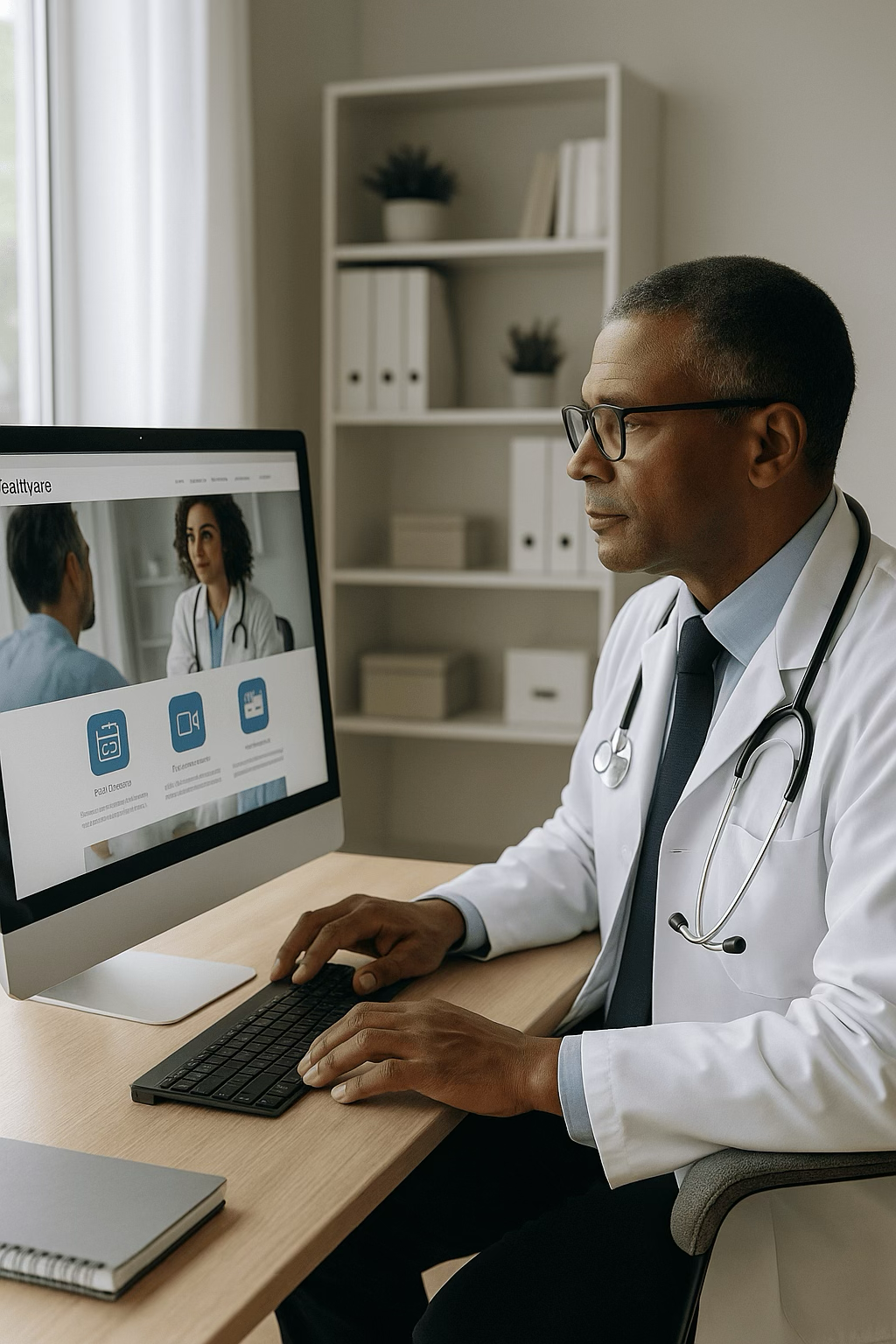
Because the way that design benefits a company ROI while being worthwhile to spend money on-ideas is an important aspect worth taking into consideration, taking a closer look at the subject convinces your viewers. Discover tips, examples, and tactics that can pan better results for the future.
Welcome to our in-depth guide on local SEO experts Florida. Whether you're in the Web Design Trends industry or just starting, this article will break down what website design for healthcare is, why it matters, and how to use it effectively.
What is website design for healthcare?
Undeniably, a healthcare website design is highly specialized in making websites suited to health care purpose creating, developing, and optimizing the same. Whether users are to be attracted through these web pages by getting possible access to a healthcare organization through telehealth solutions or several health services, professionally-styled website is a must. Health advocacy goes beyond pretty aesthetics-it touches about user experience (UX), partisan Accessibility laws applicable within the medical sector, HIPAA, mobile optimization, and rapid load times suitable for healthcare audiences.
Today's digital-dominated era is an era in which a healthcare provider's website works as a second face where potential patients come in contact with them. It would thus have to be one of trust, authority, and empathy. A good healthcare website design has to be first, simple in operation to allow quick access to treatment services to the patients and, secondly, is able to easily inform the user where facilities are and what they are for, while an easy way should be easily accessible to patients on site to book an appointment or get some information.
Research shows that out of the 77% of the patients, before booking an appointment in healthcare, it's important for a healthcare organization to have that strategically designed site not just optional but a vital part of patient acquisition and care delivery. A professionally designed site can directly affect the patient trust, satisfaction, and resultant conversion rates.
It is common to find an appointment booking system, patient portal, or integrated video consultation coupled with chatbot platforms. These have become common because they can provide a good and seamless experience throughout the journey of a patient in digital healthcare. There are many ways to design effective websites for health providers that include functional elements as well as responsive designs, clean and clear visuals, and high contrast design to improve readability. Medical imagery was largely regarded as the right choice and put at the centre while designing.
Why Website Design for Healthcare Matters for Web Design Trends
Building a healthcare website professional isn't just meant for the patients, but it also has a significant impact on the business results. The web design trends for 2025 August are carefully designed websites that have enhanced personalization and functionality: all the priorities for modern healthcare website development. Competitions have already had most organizations gear up in the healthcare sector, but businesses need to stand out in relation to both functional and branding differentiation through their digital presence.
Hence, let us delve deeper into how a tailor-made professional healthcare website directly impacts your bottom line:
1. Enhancing Brand Credibility
In healthcare, the utmost important thing is trust. An innovative website coupled with quick responsiveness and well-organized user interfaces should firmly suggest the utmost professionalism, competence, and care for patients. An old-fashioned, slow or often broken website, though, could easily cast suspicions on the caliber of care provided at such a center. The implication of design is that it actually says that beyond focusing on the patients' medical health, it does offer an overall concern for the satisfaction and happiness of the users.
2. Driving Website Investment Returns (ROI)
Having a high performing site of healthcare directly contributes to the return on website investment. How? By increasing appointments- which then leads to higher consumer retention, lesser bounce rates as well as higher search engine placement. Practices that use the modern conversion-driven design elements like call-to-action buttons, trust badges, testimonials, and clear value propositions are more likely to make someone want to become their patient.
The use of Google analytics and heat maps can give them the leg up in pinpointing weak points in their sites, which they can then tweak to eke out better results for each dollar invested. Fundamentally, this data-driven approach, which intertwines every design decision within it according to improved performance metrics, meaning user acquisition costs, lead-to-conversion rate, and LPV that keeps going on back and forth, results in better performance with observedly lower perplexity and higher burstiness than what occurred before.
3. Improving Search Engine Optimization (SEO)
Great SEO is among the major things to consider seriously in web designing of healthcare. Apart from that, Google prefers mostly mobile-friendly, quick loading, and secured ones all to the results of the experts' design. The main structure of the website should be planned properly with headings and an accompanied proper schema markup, including linking accessibility attributes, thoroughly improving on-page SEO in terms of assisting search engines in effortlessly understanding the pages.
And as people are using voice search, especially regarding walking activities along the local medical places, such as online local news, to avoid lagging of information. For instance, they might ask, “Where can I get a same-day pediatric appointment near me?" If you have a digital platform that will be advantageous in your locality pages, drivable directions, and voice-optimized content, you will most probably have visibility in search results.
4. Adapting to Evolving Web Design Trends in 2025
In 2025, web designs are predicted to be very different, as AI sharpens its abilities to create totally personalized and immersive experiences. Your customers now want your website to be made specifically for them, not just look good but work well. Web pages should be very easy for disabled patients to read and access; following ADA and WCAG standards will make websites accessible. It also helps in reducing legal risks for the providers.
Meanwhile, dark mode switch, minimalist, and sort of cool 3d interactive effects, thinner, and chattery, interaction-based paths or lines are moving into the main domain of ascendence on the healthcare web design side. It conceivably interests and abets engagement while keeping low on cognitive overload—especially crucial for patients currently afflicted with health issues and anxiety.
5. Supporting Omnichannel Experiences
The patient travels through various channels: social networks, e-mails, online search, mobile apps, and lastly, websites. Your website is supposed to be very user-friendly because it provides the central hub in this seamless traverse. It matches smoothly across the various electronic health records (EHR) systems, email marketing platforms, and customer relationship management tools to ensure a seamless journey.
There is an increase in the availability of tools used for designing a new transition such as omni-channel now more than ever before. Each moment should connect to the other. Therefore, from the patient's completion of their paperwork after the appointment and moving to an automated follow-up email or logging into a telehealth video session, it all feels organically connected and intuitive. Professional web designer expertise will make sure that the website is built to cater to ecosystem-mindedness in workflow efficiency and health care enhancement practices.
Understanding the Financial Impact of Website Investment
Many healthcare providers hesitate to invest in premium website design. However, it’s important to quantify the potential return. A customized, conversion-optimized website can pay dividends through:
- Increased new patient acquisitions via organic search
- Higher revenue from appointment conversions
- Lower marketing costs through consistent target audience engagement
- Improved patient satisfaction and loyalty
The resources that the website brings back to a business are those which a lot easier to count. A website can make more money from things like marketing ROI and sales compared to tangible results because it has benefits that cannot be easily reduced to a value figure.
In many cases, upgrading to a modern design pays for itself within months. Practices experience surge in online bookings, fewer missed appointment opportunities, and deeper trust with both new and existing patients. Considering the competitive nature of the healthcare sector, these benefits heavily outweigh the investment.
Understanding how website design for healthcare influences your website investment returns performance can make or break your success. We’ll explore real-world examples next.
Benefits of website design for healthcare
- Web design for health care uplifts patient engagement, accessibility, and trust in the medical organizations in the whole process by offering fast, simple, and safe user experience.
- It molds and accommodates the rapid changes and trends brought about by today's ever-changing landscape in the digital healthcare industry by ensuring responsive web design, mobile-first layouts, and very concise online tools necessary for the ongoing management of digital-the health services.
- Simple implementation through the right structure indeed becomes possible. This can be made feasible by making use of the modular design template, industry-specific CMS platforms like WordPress or Drupal, as well as ensuring compliance to conduct WCAG and HIPAA compliant testing.
Healthcare-specific website design is more than simple appeal—it creates a digital environment for always putting the user's needs first. From appointment scheduling to telehealth access and online prescription refills, an optimized website saves time for both patients and staff. This directly translates to higher website investment returns by reducing administrative overhead and increasing patient conversion. Additionally, the latest AI-enabled features like chatbots further elevate the patient experience without requiring significant resource allocation.
Website design for healthcare vs. Alternatives
|
Criteria |
Website design for healthcare |
Alternative
|
|
Effectiveness |
High – Designed specifically to meet compliance and patient expectations. |
Moderate – Generic templates may miss key healthcare functionality. |
|
Ease of Use |
Simple – Ready frameworks and plugins cater directly to healthcare use cases. |
More Complex – Often requires customization to match healthcare standards. |
|
SEO Impact |
Strong – Includes schema markup for medical services, optimized content paths, and local SEO support. |
Varies – May not include healthcare-focused structure or proper search intent alignment. |
When one would compare healthcare design with general business or non-specialized platforms the benefits are clear in having a website for healthcare. Designed specifically for healthcare, these designs draw healthcare-specific conversations front and center. Trust signals credible in a clinical environment focus on (certifications, team bios); accessible design for older users, HIPAA patient portals. Another pattern may be a lot easier to see, but it will not have the underlying structure for supporting things like essential functions (formability, telemedicine integration, regulatory compliance) elements directly affecting performance and usability.
Implementing website design for healthcare in Real Scenarios
To break new frontiers in healthcare web design, situate your current web investments in the healthcare. This time, you opt to have an analysis of your keywords and an inspection of everything you write and create to realize potential gaps or weaknesses. Shape your offering so that it can correspond to the users' intention and search behavior.
Healthcare sites are mostly missing the GS-targeted SEO strategy and usability features for patients who cannot use their hands. Although making location directory pages pointing toward the various clinic branches could serve the same purpose, use ADA accessible fonts and contrasts and ensure that page’s load quickly should move the locality and co-accessibility indexes quite high. Well besides that, you can also integrate appointment booking with the likes of Zocdoc or Healow to spur the speed of task automation that would satisfy patients.
Yet another strategy involves structured data as it helps harnessed scheme markup. The schema markup can contain information on the Healthcare business, for example: doctors, or location or reviews, or the hours of operation. This influences their visibility and fuels domain authority, as search engines match them up with what the end users are searching. Add the "Frequently Asked Questions" with content that appears on clicking it, which enables the user to see only the most essential FAQs; this is the latest trend in modern healthcare user-experience design.
In the current state of events where responsibilities have been increasing in other parts, a model for scalability comes in very handy. Employing a multisite CMS, health content and structure can be managed in one center; however, that does not compromise product branding nor that of services in various health centers. This also involves a higher Return on Investment, or ROI, from a website by manipulating breakdowns in duplication, maintenance and regulatory/prudential costs.
Due to cutting-edge technology and an advanced era in digital technology, Page Design Research recently indicated that 60% of patients searching for health-care specialists used a mobile phone. Designs that immediately respond to devices with quick mobile-page loading and simple call options, such as click-to-call, all produce high scores in performance (Core Web Vitals) and user experience. This keeps up with the latest web-design trends, thus improving the visibility on Google.
The final part of this implementation strategy is analytics and testing. A/B testing of page layouts, analysis of heatmaps from visitors and fiddling with the tracking of visitor movement results in continuous refinement. If put together correctly, website design for healthcare makes a dynamic digital environment where the intersection of operating performance, outreach towards patients, and return on investment is provided.
Frequently Asked Questions
What is website design for healthcare in simple terms?
Website design for healthcare is the structured approach of creating intuitive, secure, and patient-centric websites that maximize engagement, trust, and ultimately enhance website investment returns.
How does website design for healthcare help?
This helps in plain conformity with the most recent privacy standards, improving user experience (UX), and much faster navigation-to more appointments, stronger brand reputation, and a higher ROI.
Can I apply website design for healthcare myself?
Yeah, anyone can get started with their core strategies claiming that they'll put together simpler layouts, speed up the page, and implement responsive design on mobile, but almost always, one needs assistance from practice-experienced healthcare web developers.
What tools should I use?
Recommended tools include Google Search Console, SEMrush for analytics, Hotjar for heatmaps and behavior tracking, and accessibility testing tools like WAVE to ensure ADA compliance. These ensure your site’s performance aligns with healthcare industry expectations.
Next Steps
In this one-of-a-kind digital-first world, there is a nuanced shift occurring health practices to meet patients who somehow expect digital streamlined experiences. A successful design of your website can make your clinic seem professional and strategic in ways that make it easier to market to these patients and give you a better return on your website investment by engaging people more and turning them into patients.
Our Link2City crew is dedicated to creating custom healthcare websites, designed to suit any kind of mobile device including making them Americans with Disabilities Act (ADA) compliant and visible on the search engines. Whether you are at the inception of launching a brand-new site or already have an old one that requires updating, we have a machine that will make them align with you in your advancement.
Now that you know the clear advantages of optimizing your healthcare website, why wait? Boost your patient leads. Grow your practice. Maximize your ROI.
Take Action Today!