

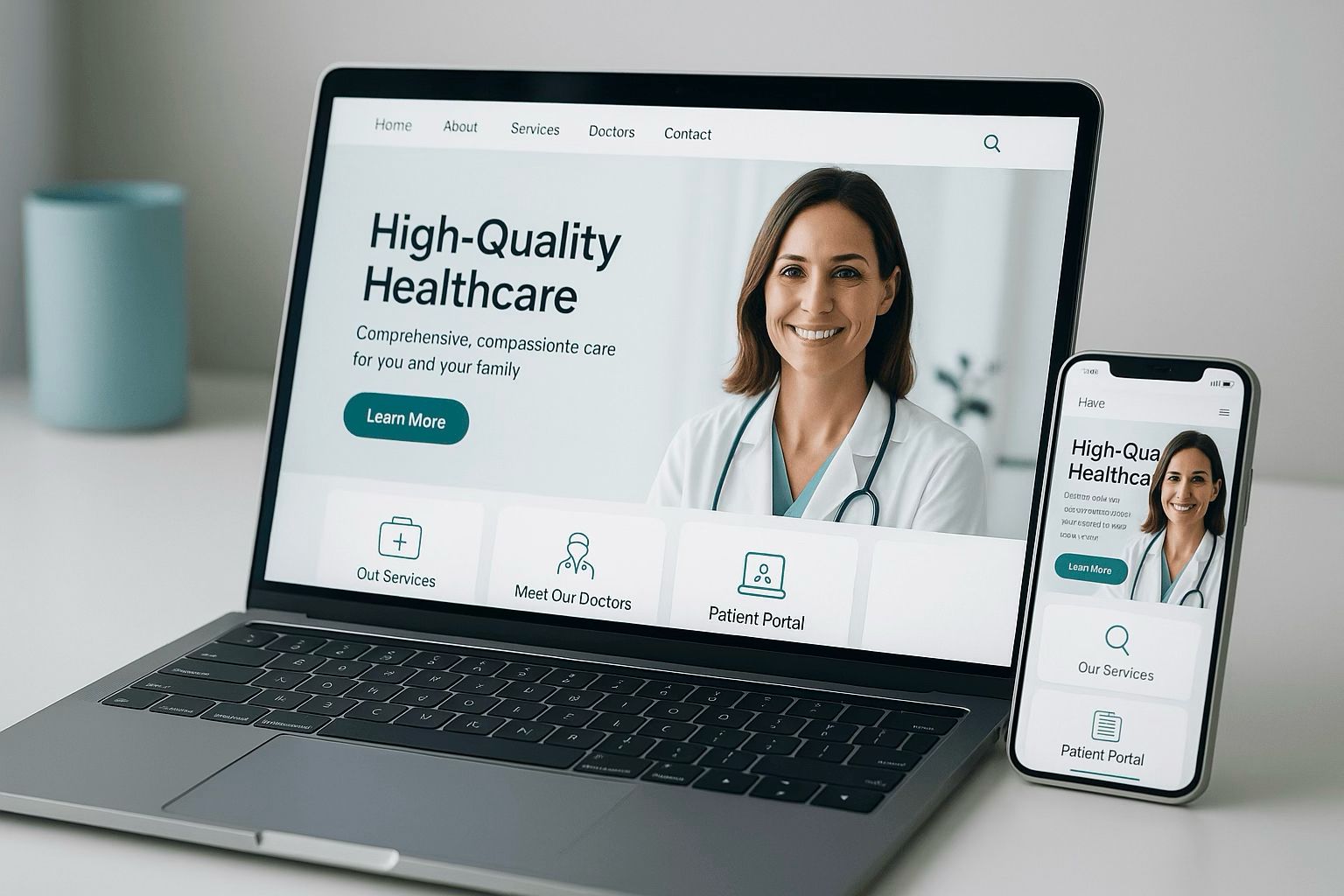
The Top Web Design Trends for 2025 will give you an overview of it all, even those that are related to health care website designing. Check out some of the tips, examples, and strategies in order to get much more from your website.
Welcome to our in-depth guide on website design for healthcare. Whether you're in the Web Design Trends industry or just starting, this article will break down what website design for healthcare is, why it matters, and how to use it effectively.
What is website design for healthcare?
Web design healthcare which is making a website, optimizing, and then maintaining healthcare institutions with medical professionals, clinics, healthcare tech platforms, and wellness professionals, should be having in 2025 not just a neat home page or contact form but to provide a great digital experience that aligns with patient needs, makes use of modern navigation patterns, and is in line with the standards of accessibility.
It is to enforce the principles of the field which are user experience (UX), visual branding, interaction, mobile responsiveness, and compliance with legal policies like HIPAA in the United States. Possibly, a contemporary healthcare website is expected to be able to render a clear access to different services, online appointment systems, opportunities for patients to log in, as well as real-time chatting in relation to the medical staff-even ensuring data security and user trust.
Today, digital health evolves increasingly such that healthcare patients require the same seamless personalization as website interfaces banking or consumer apps. This implies more than a solution regarding web design trends impacting online outreach, brand execution, and patient acquisition, satisfaction, and retention.
Why Website Design for Healthcare Matters for Web Design Trends
It is expected that by August, 2025, design in healthcare got even more progressive with the various developments observed over the past couple of years. When telemedicine grows more popular and smarter devices form an integral part, it will be perceived more as user-centric design. We have seen this trend affect many industries and practices, and it can also be taken in the light of a mobile-first search experience and a need to meet the requirements of personalization for particular user browsing activities.
There is likely to be a great deal of discrepancy as concerns everyday digital competencies in the public health domain. It is widely recognized that the average health seeker is typically older and will tend to find certain design elements, as well as faraway and cramped fonts, hard to read certain things. At this time, we are working at the notion that inclusivity in design means making it workable for every person, regardless of age, laptop, or disability, without being overly concerned about renegotiations. Some adjustments, like flexible text sizes alongside vocal browsing, color differences between the webpage background and the text, are becoming widespread in international health hero websites, in particular.
A very significant healthcare web design trend expecting the year 2025 is the trend toward the use of artificial intelligence (AI). The rise and use of clever web technologies on provider websites are driving this trend. In the future, it will be normal for health websites to translate this into chatbots that answer insurance questions or AI-driven internet cars for homepage symptom checkers. These tools typically result in time savings for patients and make healthcare organizations more effective while delivering much better service.
Functionality ranks first, while aesthetics would dominate. In 2025, the colors for the most fashionable color palettes shift toward softer and cleaner ones including whites, ocean blues, and sage greens, meant to produce calmness and trust. The sans serif type on the page is quite clean and is not burdened with too much information. Less is more when it comes to animation, but it should be developed with an everyday function in mind (e.g. showing loading times in forms for transitions). Micro-interactions should reassure users that they have genuinely submitted the action and that it is being processed when they click on an element like a button.
Even more compared to the previous years. Over 70% of patients nowadays use mobile devices to scrutinize the health care provider, and 10.5% do so before booking an appointment. Thus, websites of medical care units become extremely popular nowadays: they all have been adopting the "mobile-first" development strategy where every design decision is made for optimization to search with the small screen first and then move into the bigger screen.
Emerging Trends in Website Design for Healthcare
A few of the most important web design trends that are shaping the digital healthcare transformation are as following:
- The Integration of Voice Search: Voice Search Integration is really essential for this age when the smart speakers that make up the hardware of this function are in high demand. The Voice Search Integration goes to the length of enabling patients to say their needs in order to find services.
- High AI-Powered Personalization: The content will be rewritten on a site for healthcare over the basis of the user's behavior, site location, and browsing history. With this, personalization would be higher, and patients would get the information more appropriately.
- Patient Portals are Secure: A well-structured, rapid security patient portal that a user would search for should have the ability to access records, put appointments, and communicate with healthcare providers from a single system-another, single dashboard.
- API Integrations of Health App: Now, the major deployment of the device is using wearables and mobile apps for health with the website so that healthcare patients can monitor heart, see progress, or track conditions, through these mobile applications.
- Thinking of design as multilingual is the very first step when entering diversified populations in healthcare businesses. Making available the contents in many languages should increase access to the information and, at the same time, spread in a large manner.
Understanding how website design for healthcare influences your paid advertising comparison performance can make or break your success. We’ll explore real-world examples next.
Benefits of website design for healthcare
- People feel empowered when a site is designed for healthcare because it paves the way for them to navigate very easily without coming across difficult layouts. For they find what they are looking for, book appointments, and communicate with those overlooked.
- In addition policies that set the frameworks necessary for a growing consistent webpage design are in place, for they include such qualities as responsive layout, fast-loading pages and mobile-first experiences - all of which are considered key elements of modern healthcare web design.
- Simple implementation with the right structure is achievable through templated frameworks, accessibility-first design systems, and optimized content hierarchies tailored specifically for healthcare use cases.
Website design for healthcare vs. Alternatives
|
Criteria |
Website design for healthcare |
Alternative
|
|
Effectiveness |
High |
Moderate |
|
Ease of Use |
Simple |
More Complex |
|
SEO Impact |
Strong |
Varies |
Implementing website design for healthcare in Real Scenarios
To conduct the health website design, the most primitive requirement should be located into the current modern web design strategy gaps. In order to mend the gaps that you pointed out, some keyword tools and content audits might present you some opportunities for enhancement. Now, you need to use these identifications to make your content tailored to user intent and search behavior.
Ensure a UX audit by looking at healthcare in specific UX principles on your current website. These include navigation. In addition to this, there is appointment scheduling, medical resource access, and possibly HIPAA compliance, so ensure you bring everything into consideration when doing your site audit. Pinpoint the patient experience areas, say slow load times and hard-to-read or hard-to-understand layouts.
These are essential factors influencing the level of patient trust and engagement that could be developed towards your digital services.
Let's talk about structure and design. Such would come up to modern Web Design Trend items. It could mean switching to responsive features like Bootstrap or Tailwind CSS, careless color schemes that integrate accessibility factors, and the simplification of CTAs (calls to action) to increase leads. In this light, the design could offer a very white space accompanied by intentions for users to focus on essential materials, such as symptoms checklists or referral steps. Some of these were having clean designs.
On the other hand, demonstrations have proven that clinics and hospitals applying modern website design to healthcare have shown increased patient appointments, booking rates, and reduction in bounce rates. Cleveland Clinic, as an example, renovated its website for faster loading speeds and adjusted its mobile usability. As a result, patient engagement and organic search traffic were both observed to improve, with the SEO effect of well-optimized structures and healthcare-related schema markup visible.
Yet another strategy might be to build trust through content. Structured data such as physician bios, virtual-tour videos, and patient testimonials bring an emotional depth to it, and while humanizing, also make it credible. This then starts to make search engines understand about the variety of medical practices, insurance, and kinds of services that are there in these web pages they want to rank in search results.
Usability is kept simple: improve design by implementing such things as sticky navigation, clear labeling, logical categorization of contents, etc. Specific for multilingual communities, an idea like dynamic language switching enables insightful language-switching mechanisms for users who are not English-fluent as native speakers, further expressing inclusivity, and transforms a patient-centered design—an important norm in health care UX.
However, you should track KPIs post launch to measure your success: views per session of page, interaction with the appointment forms, bounce rate, and so forth will help you fine-tune this regularly important aspect of site performance so that over time you can observe such changes and amend them in order to reflect real-user behavior, thus enhancing healthcare site alignment with evolving web design trends and patient expectations.
Why Website Design for Healthcare Matters Today
What is imperative is how such digital infrastructure has spilled the design of websites for the public health delivery practice. People get impressions that are combined with a core delivery of the message practiced by state-of-the-art web design for healthcare. First impressions mean a lot, not only as it means well-thought-out ways to present a lot of critical health information, which instantiates function aesthetics rather than just aesthetics. A well-designed healthcare website often represents a patient's initial engagement with a provider and sows trust and communication.
Nowadays, patients are no less than a static website. They want more than the obligation and merit for appointment scheduling at a time when need arises, access to medical documentation and telemedicine facilities, and a mobile-friendly design. In this way, strategies shall change accordingly in order to encompass the web development in a broader range of aspects related to the user.
This puts immense pressure on the health care organizations as it is imperative that design is aligned to what the patient requires and does online, a real-time umbrella sort of a thing.
Trends Shaping Modern Healthcare Web Design
Make sure the UX/UI design elements incorporated in the website are in tune with visitors so that given no drastic design changing should be carried out on a new website for the healthcare site to keep up with and shoot down its competition. Following are some newly evolving trends in health web design.
- Telemedicine Integration Attachment: These Telemental health technologies are applied to a website so that they make these services available faster and friendlier to the user.
- ADA Compliance: It might be like they do not say it, but most health professionals have websites that need it: a website that one can access without a barrier. A level-locomotory site, on the other hand, fulfills requirements such as contrasting colors, at least some keyboard navigation, and screen-reader friendliness.
- Mobile Optimization: In business, over 50 % of site visitors use mobile devices to get on the site; with this, the site is optimized for reading on mobile devices using responsive design-which would allow everybody to still access information for the business on the go.
- Secure Online Portals: Understood to comply with federal law, HIPAA compliant patient portals protect confidential information and allow patients to schedule appointments, request a prescription refill and coordinate care provider communications.
- AI Chatbots: Such assistants can answer commonly asked questions, aid site navigation, and fix patients' appointments instantly, on a 24/7 basis. It equates to better customer satisfaction and overall work efficiency.
Merge this with powerful SEO with clever navigation will be a very effective online asset that establishes the credibility needed to convert.
Best Practices for Website Design in the Healthcare Industry
To gain the full benefits of these skilled skills at the institution, what makes a website is the application of best practices that give utmost value to both users and compliance to the provisions:
- Clear Site Hierarchy: Make use of intuitive menus, breadcrumbs, and internal linking to reduce bounce rates and enhance ease-of-use.
- Loading Speed: Compress images, cache the browser, and limit the load of scripts to quicken the speed of the site and that fact should be one priority aspect regarding Google ranking.
- Content Clarity: Keep medical jargon away from your content; make the text as direct and simple as you can and write on 6th–8th grade reading levels.
- Visual UX: By contrasting colors, consistent fonts, and strategically used white space, the page makes it simple for scanning among the audience and even visually pleasing.
- SEO Optimization: Improve your ranking by including metadata, structured data, and some targeted keywords, for instance, "modern web design" and "healthcare services in [location]".
In understanding user intent and designing according to that, your healthcare website will no longer be just an information source-it will be the close assistant of these individuals in all matters related to health.
Future Outlook for Healthcare Web Development
They will move a lot further than merely a communication point with the advancement of AI and data analytics, along with the integration of wearable health devices. More behavioral data and health-monitoring tools are utilized for the best personal experience. Moreover, websites will be used as control centers for patient involvement with tracking powered by predictive analytics and health-data communications in real time.
Entities that utilize web platforms that are intelligent and fast are setting up the future of innovation. The new web design is an absolute must now rather than an option. This is just something that future generations require in the digital age of health.
Frequently Asked Questions
What is website design for healthcare in simple terms?
A design concept strategy for medical websites as a technique used to modernize Web design focuses on structured, intentional means.
How does website design for healthcare help?
It helps improve performance by aligning your content with search behavior and industry best practices.
Can I apply website design for healthcare myself?
Absolutely. With the right tools and structure, even beginners can begin applying these principles effectively.
What tools should I use?
Start with Google Search Console, SEMrush, and keyword research tools. These provide visibility into how website design for healthcare impacts performance.
Next Steps
It's high time that you thought about perking up patient engagement, raising search visibility, and instilling trust through strategic web design within healthcare.
- Schedule a Free Consultation to Discuss Your Needs
- Explore Our Web Design Solutions for Healthcare
- Understand Federal Guidelines for Healthcare Web Design
- Stay Updated with Global Health Digital Trends via WHO
Request Your Free Digital Marketing Consultation Today!