

What is website design for healthcare?
Healthcare website design is the process of creating contemporary, user-centered websites catering specifically to healthcare-related needs such as doctors' offices and general practices. Meeting the demands of increasing patient expectations, digital-first interaction, and HIPAA compliance, healthcare must now consider design from a perspective of form, texture, and functional utility. In 2025, information wanting to reach far still traverses what is construed as more art in the web design community consisted of modern and cutting-edge techniques to play the game with them; such a way of proceeding took the lead toward project outlining-not for money; knowledge was the leading light. The designs offer a good degree of accessibility, fast-downloading content, crystal-clear alerts, and an on-point navigation system, all clear, concise, and to the point. Today, web design has become considerably involved in patient engagement. Health design affects everything from appointment setting to viewing lab results.
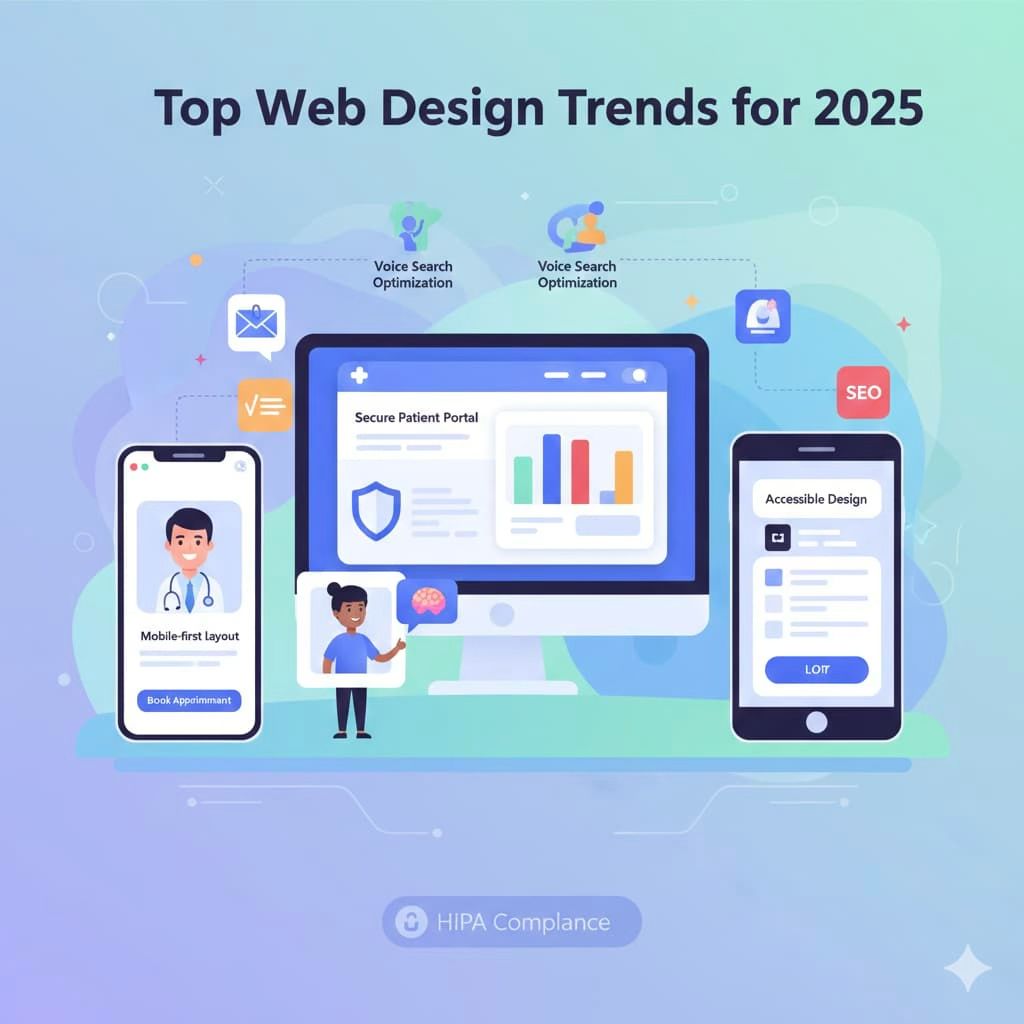
The main items to be found in the healthcare web design in this day and age include:
- A mobile-first layout: A high number of patients now access medical information and services via smartphones.
- Indicated navigation: Basic menus allow prospective patients to see insurance details, doctor listings, and quick FAQs.
- Secure portaling: Ingenious Health Insurance Portability and Accountability Act (HIPAA) applicable platforms that guarantee the sanctity of sensitive patient data.
- Accessible design: Screen-reader-friendly, high-contrast themes, language translation, etc. are rapidly becoming routine.
- AI tools: Providing chat support, symptom checker, and triage with AI.
These items explain how modern website design is constructed for the special considerations of healthcare institutions and user expectations, in turn using the principles of user experience (UX) to construct Web health-friendly and intrinsically beautiful and operationally collaborative websites.
Why website design for healthcare Matters for Web Design Trends
The design of a healthcare website has a direct impact on patient satisfaction, operational efficiency, and brand trust. With more than 70% of users now researching healthcare providers online before scheduling an appointment, the website becomes your digital front door, making a strategic design a must for healthcare providers in 2025. Empathy-driven design is one of the top trends this year. Here we are looking at UIs, which cater to the specific emotional needs of patients. Colors, fonts, and content structures have been picked on purpose to thaw any tension and create trust. For instance, users are attracted into a zone of no stress, inducing them to feel safe, with soothing color palettes, such as pastel blues or pale mint-green, working sweetly together.
Another point-of-relevance is voice enabled design. Putting in wake of current foray into smart devices like Amazon and Google, the best health websites now feature voice search functionalities that allow users with varying degrees of impairments to access medical information conveniently. Designers in this environment are developing at a rapid pace, typically for the target market of tech-savvy patients. Telehealth UX integration is becoming one of the distinguishing settings for the medical profession. Practices are creating landing pages specifically to facilitate virtual consultations, offering easy video consultation access from a login, motioning device compatibility checks, and airtight personalized dashboards.
Through SEO, the search engines today amass popularity in websites that provide responsive, highly mobile-optimized, and secure experiences. Healthcare providers who create a good user experience by means of strategic design for their audiences are in a way doing better by their patients and, on the other hand, getting noticed for better search rankings-visibility and engagement improving.
So what are the few things that a good design in Healthcare should direct on, to achieve balance?
- Increased online appointments by over 35%.
- Reduced bounce rates on websites by over 20%.
- Facilitated maximum patient portal adoption.
- More online stars coming the way of the clinic because of the smiles and satisfaction brought into the lives of the patients by them.
The role of modern web design enables consistency of the same services offered to every device. Designing a website with a responsive mindset design makes it workable to narrow the web between smartphones, tablets, and desktops. This trend is likely to coincide with 2025 digital online marketing.
Modern Web Design Meets Patient Expectations
We have witnessed a shift in patient behaviors as we move ahead into 2025. People now demand faster, easier, and more intuitive digital experiences. Healthcare websites are no exception. This is where contemporary web design is crucial.
State-of-art web design has focused on removing any friction or unnecessary noise. Long loads, endless scrolling, and confusing content — these are all deal-breakers. Modern healthcare sites that have thrived on the Internet uses dynamic content loading (e.g. lazy-loading images), content personalization that changes according to user behavior, and user-friendly forms. There seems to be a major emphasis on emotional design this year. This entails websites resonating-to usersifying through storytelling, visual elements, and individual stories. For instance, real patient testimonials, staff introductions, behind-the-scenes videos of clinical activity help humanize brands and build patient trust.
And so, we have decided to assume that the foremost and most imaginative strategy was, in fact, becoming inclusive design in the formulation of trustworthy, efficient, and effective healthcare websites — wherein which, thus all websites, alongside healthcare-related websites, must comply under the standards of WCAG 2.1 in terms of accessibility, in order to keep the additional silos of task analysis required from unleashing chaos during the initial process of prospecting and conceptualization, with every breath. Understanding the impacts healthcare website design would have on pay-per-click performance systems could be either the make or the break of your advertising strategy. So, in the ensuing portion, we might well crack into some real-life situations.
Benefits of website design for healthcare
- Healthcare website design betters patient engage-ment and the overall digital experience by providing clear navigation, fast-loading pages, and mobile responsiveness.
- Constant growth in web design trends by means of AI-driven tools, voice search optimization, and responsive frameworks custom-fit for patient needs.
- Implementations in a form that is relatively simple, structured absolutely right, and comprises certain HIPAA-compliant forms, integrated booking systems for appointments, and user-friendly interface design.
Website design for healthcare vs. Alternatives
|
Criteria |
Website design for healthcare |
Alternative
|
|
Effectiveness |
High |
Moderate |
|
Ease of Use |
Simple |
More Complex |
|
SEO Impact |
Strong |
Varies |
Implementing website design for healthcare in Real Scenarios
To apply healthcare website design, you can start by striking at gaps in your current modern web design strategy. Use keyword tools and content audits to take sniff of enhancement opportunities. Customize your content according to user intent and search behavior.
Starting with a wide audit of what your existing website says. You will need to consider mobile-friendliness, site speed, and accessibility as three core pillars that need to be present in modern web design. Healthcare websites must adhere to standards for accessibility such as WCAG and Section 508, to assist patients with visual or cognitive impairments. Build a wireframe sensitive to the needs of users. As for healthcare, users would be looking for such information as service offerings, physician directories, appointment scheduling, and emergency contacts. So an easy, clean layout and intuitive navigational structure are a must. Use hierarchy in typography and adhere to repetitive elements for seamless visual communication within.
Introducing features of telemedicine is overwhelmingly becoming a part of website design for healthcare. In addition to helping in providing access to care, these features, such as secure video conferencing, provide patient portals, and real-time chatbot support, reflects the constant application of the latest available web design trends. It is important that these tools work efficiently across all platforms mobile and desktop as well.
After implementation, the use of the given tools is indispensable. Google Analytics and Hotjar can be instrumental in helping understand patient journeys, bounce rates, conversing bottlenecks that need serious attention. All these findings would help in refining the inter connections between CTA placements, pushing for a better path to appointment flow and optimizing the right content to increase engagement.
Write content that can answer information as well as transactional queries, such as content material about symptom management, FAQ material with procedures, vlogs for health advice that do multiple kinds of work: patient education first, then guest blogging to retain brand trust, in addition to SEO improved with the help of service-related terms, ensuring trust and loyalty. Now AI allows a semi-professional to provide dynamic content customized towards his or her medium-sized clinics or healthcare setup. Healthcare website design has to put great stress on security. They must operate from an SSL-certified space with each and every piece of critical data transmitted over an encryption. The login page can be favored as a great interest for two-way authentication. With the help of the CMS engines and subsequent deployment of security patches at stovestep, one makes sure the protection of his patients' information and his name.
Scalability should be planned on the onset: as a health practice grows or diversifies (that is, by adding new specialties or locations), its website should have the capability to grow without compromising on performance or user experience. The detail with how the design modularity started emerging in today's web design culture, based on involvement in a reusable component design system for web pages.
And lastly, ongoing rounds of feedback and testing help in gestating the design with up-to-date requirements. User testing groups, using a targeted set of users, alongside patient and staff observation, are often the very ones inclined that cannot be quite expressed or concluded by analytics alone. From color accessibility tests to user preferences on UI elements, iterative designs help push usability towards current trends and user needs.
Formed around a structure of action points that display significant flexibility, current trends characterizing the advancements of web designs can be fully employed by the healthcare project, at the same time ensuring its regulation and client-focused activity while effectively managing healthcare impact. Well-designed healthcare web pages increase engagement, particularly when providing the bedrock of clinical administrative activities including brand building.
Optimizing Website Design for Healthcare: Key Takeaways and Future Steps
An investment in healthcare website design goes deal enough to be a study of aesthetics; it directly plays a significant role in patient trust and motivation and ultimately in the conversion rate. Usability, compliance, accessibility, mobile environment adaptations, a developer with the technology for digital healthcare, increased functionalities, and online interaction withstand evolutions in expectations of consumers in an emerging healthcare sector.
Best Practices for Healthcare Web Design
Holistic approach to building up for Modern health care Web designs. Herein are the basics that healthcare providers, clinics, or hospitals have to encompass in their online presentation.
- HIPAA Compliance: It is imperative for your website to process and store user data securely in order to continue holding your trust while maintaining compliance with the law.
- Clear Navigation: Allow users to be able to quickly look up services, FAQS, contact information, and scheduling forms for an appointment.
- Accessible: Allow the site an opportunity to be used by all, including screen readers, high contrast settings, and keyboard navigation for users with disabilities.
- Mobile-first: Because accounts mainly come from mobile devices, it is essential to incorporate a responsive design to a medical practice website. This also aids in mobile SEO and user experience.
- Speed and Performance: Fast-loading websites reduce bounce rates and improve user experience.
SEO and Content Strategy for Medical Sites
Your reputation and revenue growth depend greatly on the appropriate content in health care. Optimize your on-site content with keywords and educational topics that will connect to the intent of your patients' search. Schema markup, meta marks, and schema reminders should always be part of your content strategy. Google ranks high for informative, up-to-date content, which are integral components of the digital marketing strategy in healthcare.
Local SEO is another big development in the world of healthcare enterprises. Defutterstock and optimize Google's My Business Profile, create landing pages for each of your different locations, and perhaps even increase local search engine ranking through positive patient reviews.
Analytics and Continuous Improvement
Perpetual optimization remains critical for healthcare website design. Use Google analytics, Hotjar, and Search Console to track user behavior and recognize drop-off points in the patient journey. Then use data to make any required improvements to stay ahead of your competitors around your area of excellence.
Your website might perform well, but without your patient's feedback, there is no way to know. Patient feedback should be incorporated to fine-tune the web experience. Patient feedback may actually help you predict user behavior pending any changes you might make to your website.
Future Trends in Modern Web Design for Healthcare
Innovations like AI chatbots for patient triage, virtual consultation tools and real-time appointment integrations will continue to define modern web design in healthcare. Strategy for voice search optimisation and zero-click results also suggest how users access information. An adapted website adjusts itself ever more to these novel developments, demarcates patient-oriented design as the brand standard.
Frequently Asked Questions
What is website design for healthcare in simple terms?
Web health design stands as a strategy or concept essential to enhancing contemporary website design by emphasizing predefined and directed approaches.
How does website design for healthcare help?
By aligning your content very closely with search behavior and industry best practices, they may be said to enhance performance.
Can I apply website design for healthcare myself?
Yes, with appropriate tools and structure, one can apply these ideas very easily, even if they are beginners.
What tools should I use?
Begin with the Google Search Console, the search engine ranking checker SEMrush, and usability testing and keyword research tools to figure out how healthcare website design can affect performance.
Next Steps
If you're ready to transform your digital presence and attract qualified leads, now is the time to take action. Whether you’re a solo practitioner or managing a large healthcare network, effective website design for healthcare will help you connect better with patients online.
Request Your Free Digital Marketing Consultation Today! Our expert team will audit your current site and provide actionable insights tailored to your goals.